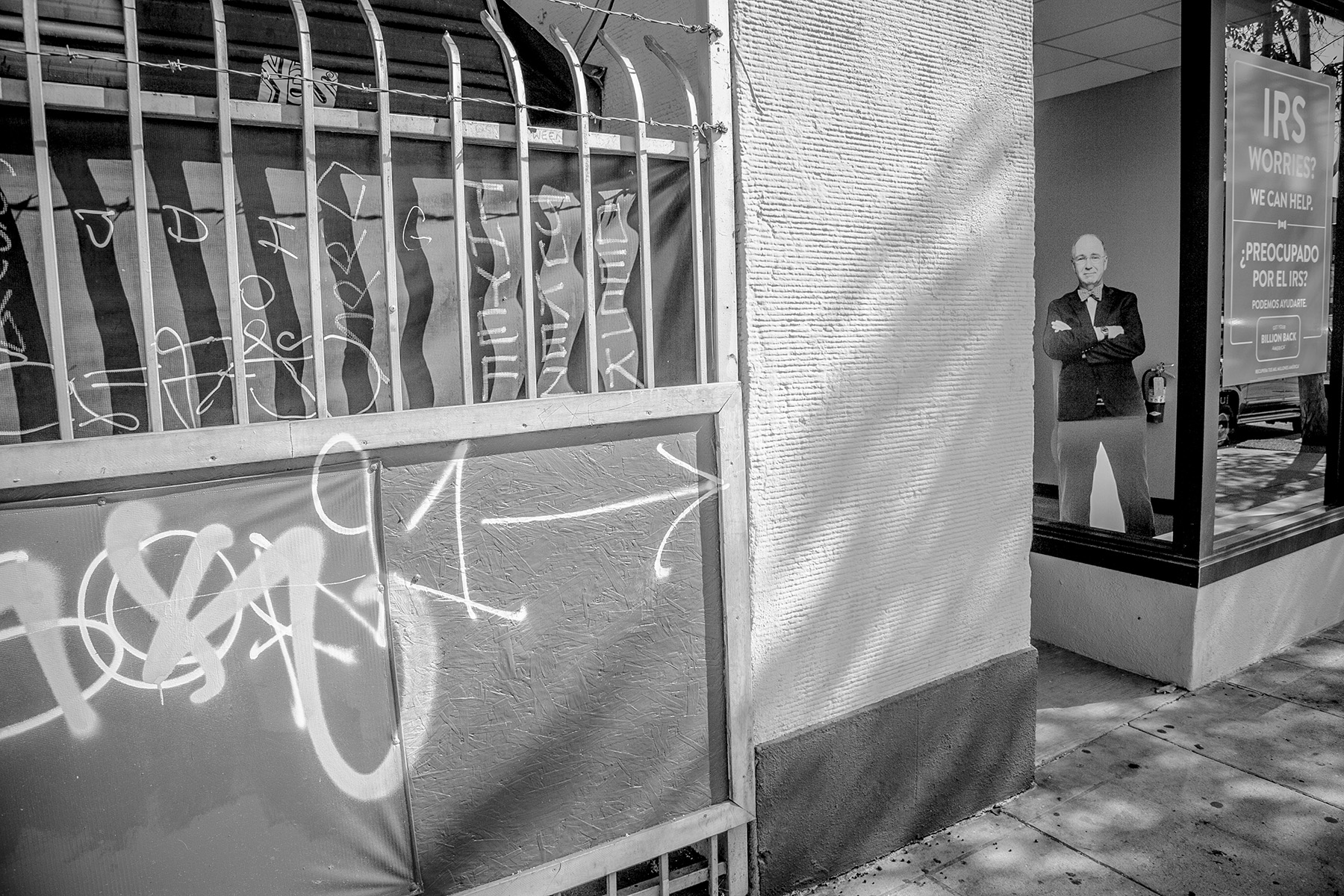
A tagged building near 4th Street and Western Avenue in Koreatown
My aim for Contested spaces – capturing the cultural layers of Koreatown, Los Angeles was to document the overlapping cultures that reside in Koreatown by walking through several of the major streets including the neighborhood’s historic borders, documenting images of everyday and common place life, signs, artifacts and architecture seen from the point of view of the street and meeting people walking about on any given day.
I focused on the multi-cultural environment of Koreatown represented by three layers: 1) a historic, Korean American, ethnic community; 2) a transnational and regional center where investors see an attractive investment space; 3) a multiethnic, local community composed of residents from Central America, Mexico and Bangladesh.
At one level, Koreatown is a traditional enclave community, represented by Korean Americans and Hispanics. Korean Americans have experienced a long history of development in Koreatown since the late 1960s following passage of the Immigration Act of 1965. This had a profound effect on the multiculturalism in the area. Many Korean Americans who arrived prior to the immigration act and following the Korean War could bring their relatives from their home countries under the family reunification provision of the act. The earliest settlement areas between 8th Street and Olympic Boulevard from the North and South and Western Avenue and Vermont Avenue from the East and West provided a space for those early settlers to create a community with less race restrictions. This allowed for the growth of an ethnic economy supported by the South Korean Government and Korean transnational investment.
At the same time, a large influx of Mexican Americans and Central Americans arrived during the 1980s. Mexican Americans, many from the Zapotecos communities of Oaxaca, arrived to seek better opportunities during a time when Mexico was experiencing income inequality that contributed to an economic crisis. Central Americans from El Salvador and Guatemala arrived to escape the violence of civil wars occurring in their countries, mostly driven by Cold War policies. Prior to the arrival of Hispanics to Koreatown, many Korean Americans hired members of their families to support independent businesses, and after their arrival, many went to work for Korean American businesses. As the Hispanic communities began to work with the Korean American community, they also began moving to the neighborhoods in Koreatown. This was a significant contributor to the multiculturalism of the area.
Although, Koreatown had become more multicultural, many in the Hispanic and Black communities felt underrepresented and unseen. Hispanics represented the majority population of Koreatown by the ‘90s. The 1992 riots represented a direct challenge to the investment projects that promoted a view of Koreatown as an area represented solely by Korean Americans.
Following the riots, developers caught wind of the investment potential of a multicultural environment with boundaries bookended by three Metro transit lines. Soon after, the city of Los Angeles implemented the Wilshire Center / Koreatown Redevelopment Project, a redevelopment project designation proposal still in effect today that had helped Koreatown rebuild and even expand quickly from the destruction. At the same time, the immigration trend began to shift from family reunification to immigration for employment based preferences in the form of a rise in investment Visas. This changed the area significantly as foriegn investors saw opportunities to build.
From one point of view, the area has become much nicer: more high-density, mixed use developments; apartment complexes and a variety of entertainment options, bars, coffee shops, spas and a golf course contribute to the appeal of the neighborhood. Many of these new developments are catered to the demand from professionals from other areas in Los Angles and investors seeking to emulate the social environment found in South Korea. In one way, the variety of food and entertainment options provide visitors and residents with a cultural experience similar to what’s popular in Korea, a symbolic demonstration of immigrant achievement.
However, many of the amenities do not cater to the majority of families and residents who live in Koreatown. For example, nearly 500 liquor licenses have been issued to businesses in Koreatown. These amenities contribute to an environment catering to entertainment seekers but consume already limited space for infrastructures that could be used to serve the greater population of families in Koreatown. One specific amenity residents have expressed a desire for were more parks for children to have a safe space to play and markets that serve fresh produce.
Additionally, more and more buildings are being demolished to make way for luxury condominiums that cater to tenants who can afford to pay between $2,000 to $3,000 per month on rent. Developers from outside of Koreatown seeking to build condominiums and luxury apartments have expressed that the appeal to the area for them is its central location to other areas of Los Angeles, an attractive characteristic to young professionals looking to live in a vibrant cultural space near a variety of entertainment options.
The shift towards more luxury infrastructure has raised the property value of Koreatown by two to three times its value from 2000. This presents a looming threat of gentrification for the majority of residents and workers who live below the poverty line. According to a random sample survey of 102 residents in Koreatown by the Koreatown Immigrant Workers Alliance, over 40% of respondents said they earned less than $1,000 per month while the most current census data shows that the average income of people who live in Koreatown sits at around $33,000, a less than 10% growth in income in the past decade. The Koreatown Youth and Community Center reported annual earnings from residents who use their free tax service at around $18,000 as of 2013. This figure is less than half of the general income of Los Angeles, which hovers at around $60,000 per year.
In many ways, Koreatown still has its roots as a cultural enclave catering to Korean Americans, but it is also a cultural space for a large population of Mexican Americans, Central Americans from Guatemala and El Salvador, and families from Bangladesh. At another level, it is a transnational space catering to the demands of wealthy, foreign investors seeking to emulate the social and cultural environment of their home country. Additionally, Koreatown has become an investment and living space catering to commuters who want to live in a fun and vibrant multi-cultural neighborhood that’s geographically near Los Angeles’ hot spots, namely Downtown Los Angeles to the East and Hollywood to the West.
My documentary style photo project shows the juxtaposition of these cultures, and each gallery provides a series of portraits with captions by local workers and residents who shared their thoughts and feelings about the way they had experienced Koreatown, the changes they had seen and the changes they would like to see.
Research Question
In what ways do the local, multicultural residents and workers experience Koreatown? What changes have they seen in their community for the past few decades? How do they perceive recent changes in Koreatown brought by transnational and regional investment?

My focus was specifically on the area of Koreatown in Los Angeles defined beyond its historic boundaries from Olympic Boulevard to the South where many of Koreatown’s oldest establishments still operate; Third Street to the North that welcomes a small Bengali community who share space with residents from Central America; Beverly Boulevard representing the official Northern border of Koreatown where mostly Central American businesses, markets, and papusa restaurants can be seen along the Boulevard east of Alexandria Street up to the Metro Station; Western Avenue to the West where pedestrians can experience a wide variety of mixed use, mixed generation, Korean and Hispanic establishments, and Vermont Avenue to the East representing Koreatown’s eastern most border.
 CONTESTED SPACES