
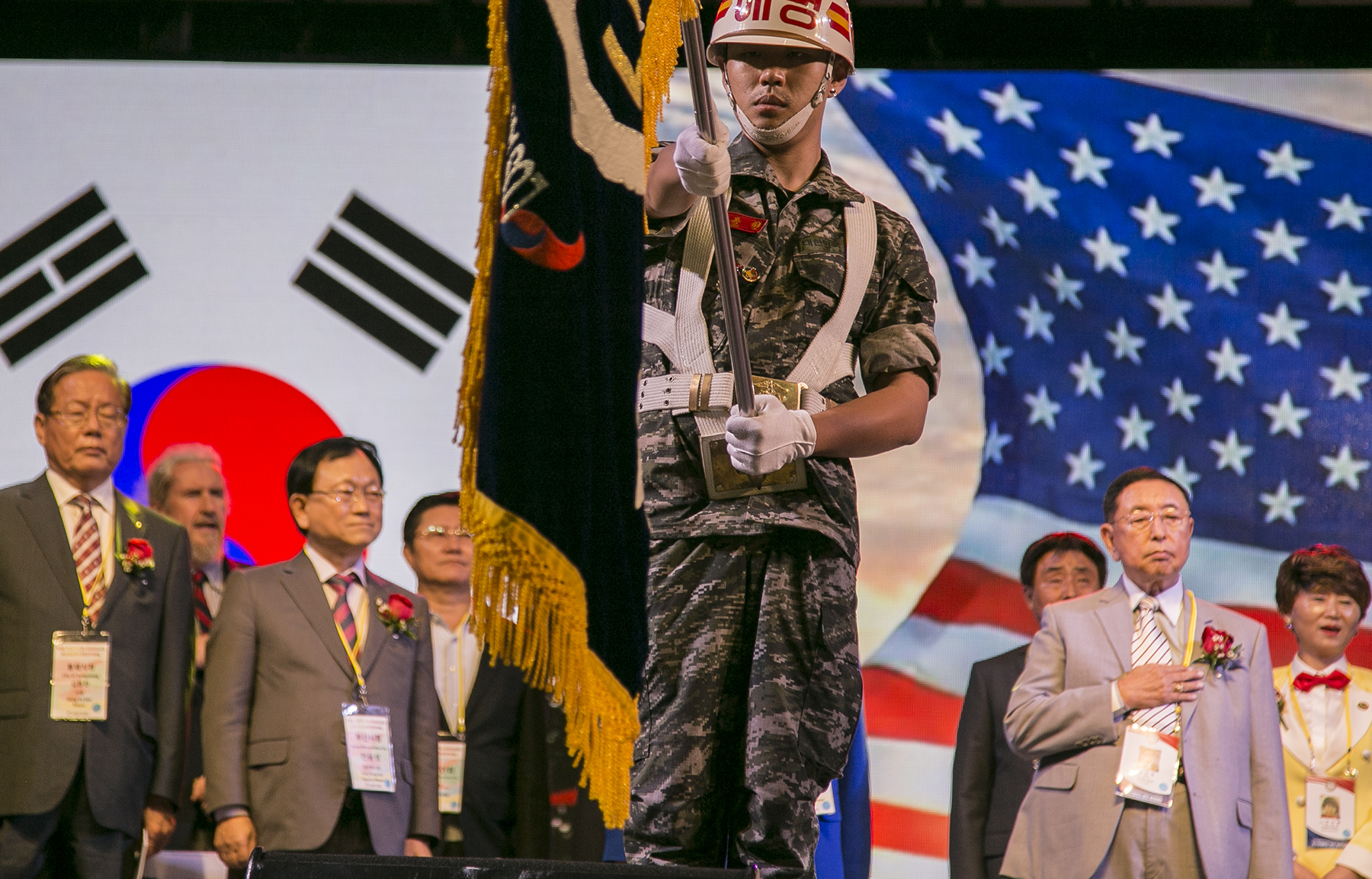
A member of the Korean Marine Corps. raises a military flag to honor both the Korean and American national anthems during the opening ceremony of the Korean Festival held every year at Seoul International Park on Normandie Avenue and Olympic Boulevard in Koreatown. The event is in its 41st year.
My aim for the ethnic enclave section was to show some of the historic sites and the older areas of Koreatown, the area’s characteristics as an enclave. There are a variety of areas especially along Olympic Boulevard that contain some of the oldest buildings in Koreatown including the Chung Ki Wa Plaza, the Na Sung Plaza, the old V.I.P Palace that was redesigned as an Oaxacan restaurant, and the V.I.P. Plaza shopping center across the street on Olympic Boulevard and Normandie Avenue.
Many of the buildings are multi-purpose buildings that cater specifically to Korean speakers, some housing a dozen different independent businesses. Many of the signs advertising goods and services on display are in Hangul catering to the first generation of Korean Americans, most of whom arrived during the late 1960s and the 1970s. The 1970s marked significant progress for the Korean American community with the further development of grocery markets, merchandise stores, banks, restaurants, doctor’s offices, cafes, and night clubs.
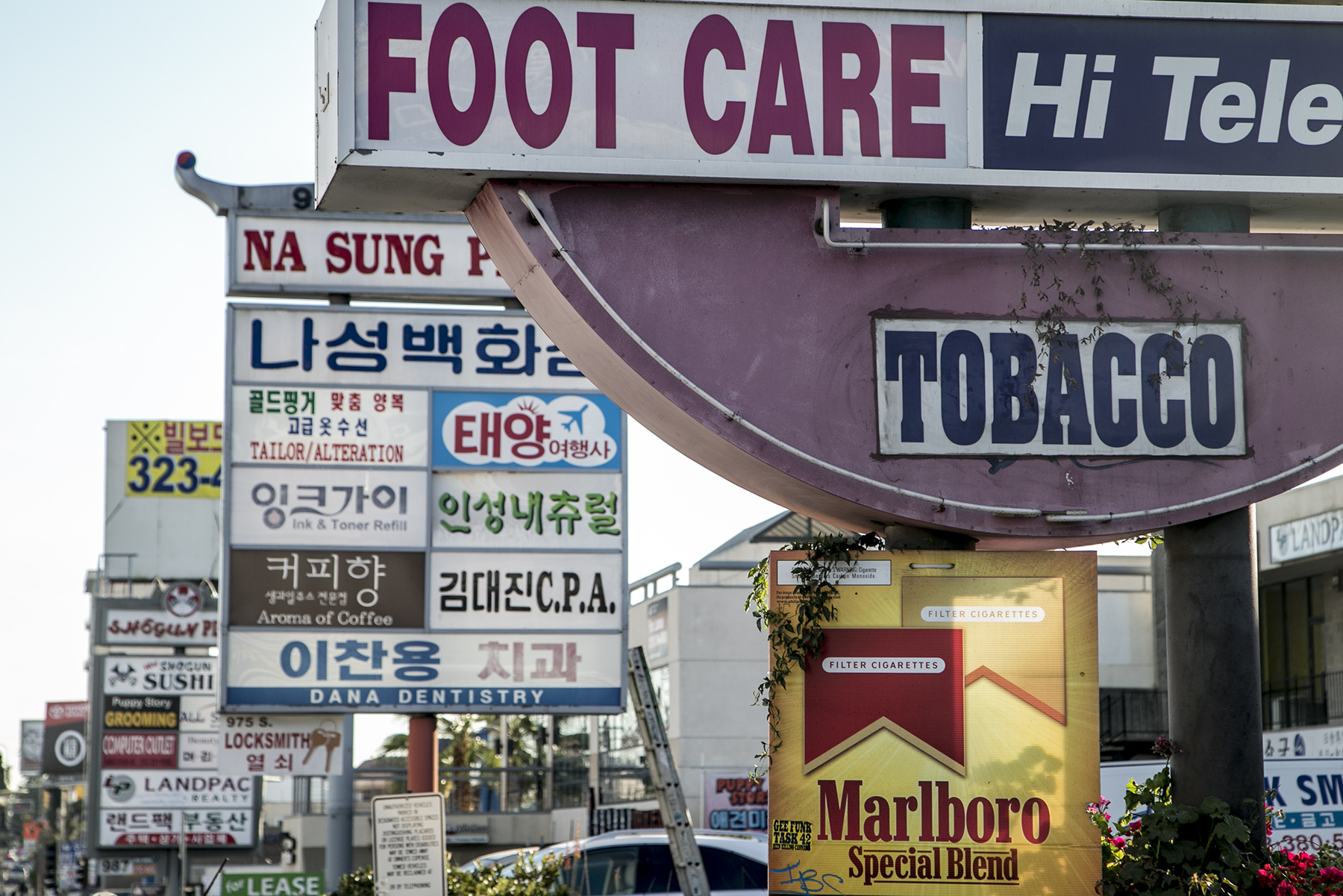
I took a static approach when documenting the signs and buildings there. I shot many of the signs tightly to place the emphasis on the Hangul writing displayed on the numerous business placards and advertisements. Certain areas of Koreatown show numerous rows of business placards displayed along the parking lots of shopping centers and strip malls lining the streets. From a bystander’s point of view, there is a wealth of different messages in a variety of fonts and colors that can be read almost like a poem in a different language. I thought of an approach similar to Walker Evan’s Signs project, juxtaposing different signs in images of numerous layers, vertically and horizontally, that he read like short poems pulled from their physical context. Additionally, many of the advertisements showed graffiti, adding additional layers to read with the juxtaposition of Hangul and English text, unknown authors adding stanzas to an open poem.
My opening image of this section was also in the static form. The photo was taken at the 42nd annual Korean Festival held each year at the Seoul International Park. It was from the opening ceremony. Members of the Korean Marine Corp. lead both the Korean and American National Anthems. In the background, a large digital screen shows both the Korean flag and American flag, and in the center foreground, a Korean soldier raises a military flag, cutting the frame in half. I read the image as a representation of a community between two places, an allegiance to a new place and an old place, a country of origin and adoption and a tribute to the Korean War, the historical pretext to the immigration act that would help create the enclave of Koreatown.
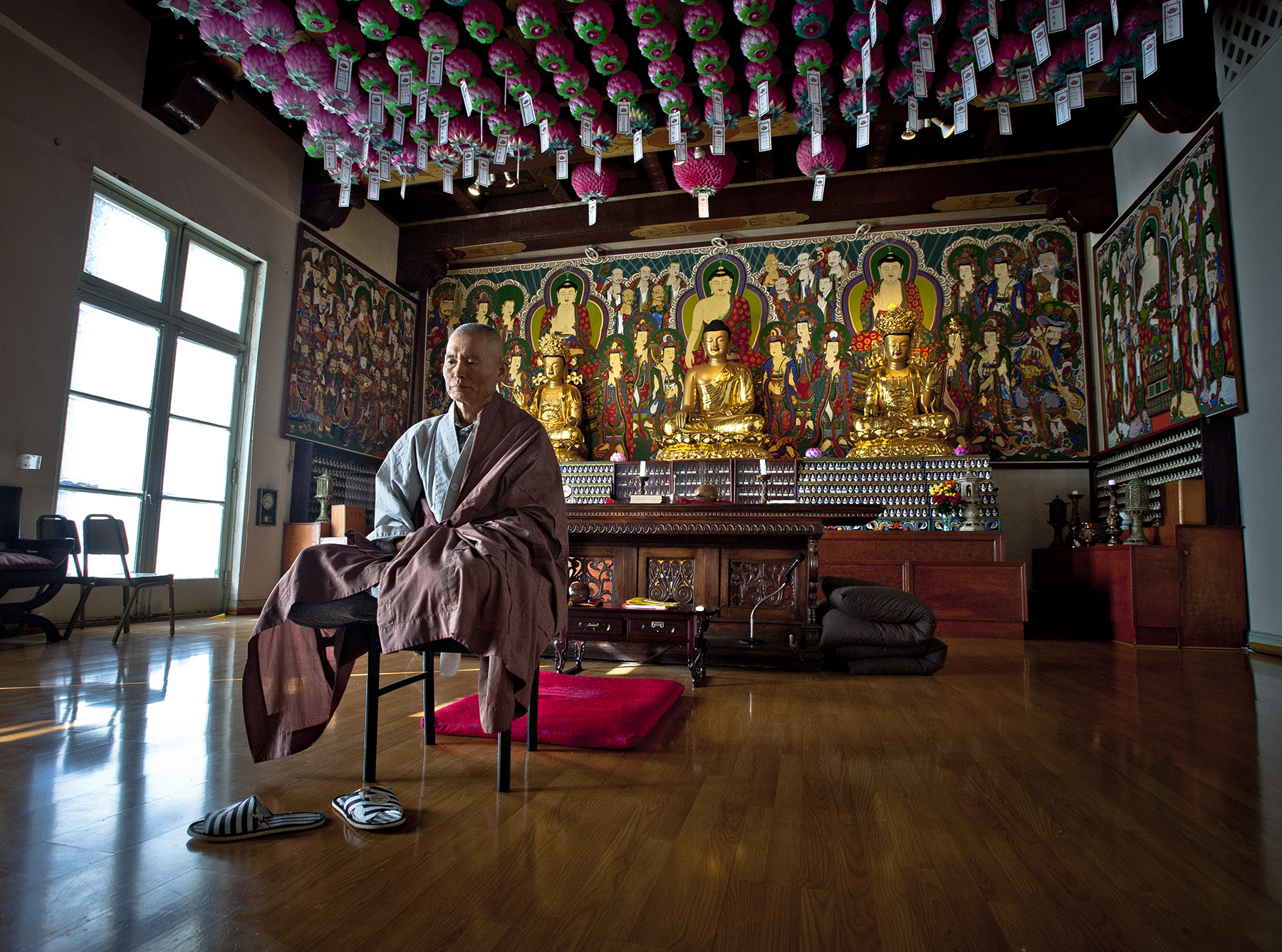
I shot most of the portraits for this section with tight, three quarter portrait framing, showing details on the clothing each person was wearing as well as some of the environmental details in the background. Additionally, I shot a couple of environmental portraits. One portrait was of a Buddhist meditation master from the Korean Buddhist Cultural Center, one of the oldest Buddhist churches in Koreatown. The Center opened in 1970 when the community was still defined as an enclave. The background of the image shows three golden statues of the Buddha displayed above rows of candles, the ceilings covered with paper lanterns. The image represented a colorful portrayal of traditional cultural iconography in Koreatown.
The survey component yielded a variety of responses. Many of the people did not speak English and therefore, could not understand my request for a moment for a portrait and a conversation about their experience living in Koreatown, and unfortunately, I do not speak or understand Korean. However, many of the people I met who I could communicate with were happy to share their point of view with me. One insightful response came from a 20 year old, second generation Korean American. She said she wanted to see more recreation centers because she felt many young people, including herself, would have difficulty finding things to do in Koreatown. Other young people I met expressed a similar feeling. She explained that many of the young people sneak in to bars or spend most of their day at PC bangs, which are internet cafes to play computer games.
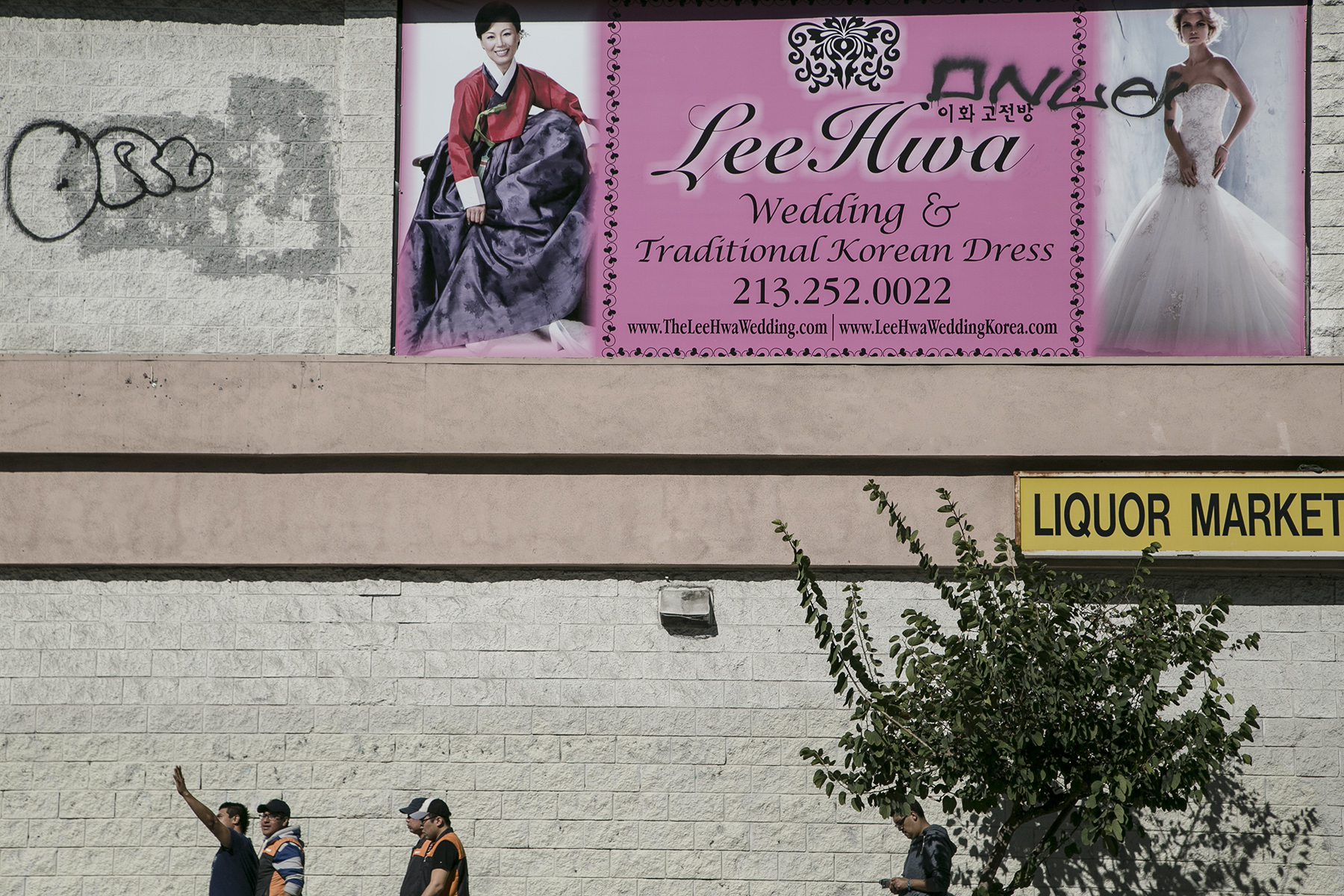
In addition to photographing architecture, storefronts provided another opportunity to show other elements of tradition that have followed the time span of Koreatown as an enclave. I spent some time photographing storefronts because I wanted to show some of the fashions on display in Koreatown. Many shops display both modern and traditional outfits for both casual and formal wear. Numerous shops in Koreatown sell wedding gowns for both Korean and Western weddings. It is common for people to have both a Korean wedding as well as a Western style wedding.
I used a lyrical approach for many of the street views I photographed, showing my experimentations with slow shutter speeds, complimentary color schemes, and moodier lighting. The Korean Festival provided many opportunities to document the movements of traditional cultural performances, the vendors providing samples to patrons in the shaded outdoor markets that line Irolo Street, the parade showing participants from various community groups that traveled through Olympic Boulevard, and the waves of people walking through the park during the four day event.

Bystanders wait for the bus in front of the Chung Ki Wa Plaza shopping center, one of the oldest shopping centers in Koreatown, known for its Korean architecture

A mixed use shopping center on Havard Boulevard and Olympic Boulevard shows businesses catering to mostly Korean speakers and some English speakers

A mixed used shopping center on Olympic Boulevard and Irolo Street catering almost exclusively to Korean speakers. The shopping center houses a variety of businesses and services as well as a Norebang or karaoke bar

Rows of business placards display business signs catering to Korean speakers along Vermont Avenue

Business signs catering to Korean speakers on Berendo Street and Olympic Boulevard

An advertisement for a meat market covered in tagging displayed on a building near 3rd Street

A billboard advertising McDonalds catering to Korean speakers overlooks a mixed use shopping area displaying signs in Hangul on Dewey Avenue

A Kentucky Fried Chicken catering to both English and Korean speakers on Catalina Street

A Koreatown street placard welcomes drivers from the Northern entrance to the area on Rosewood Avenue

The V.I.P. Plaza shopping center shows a row of business signs catering to Korean speakers

An advertisement catering to Korean language speakers near Serrano Avenue

Tagged and painted over Marlboro advertisement with Hangul letters on Fedora Street
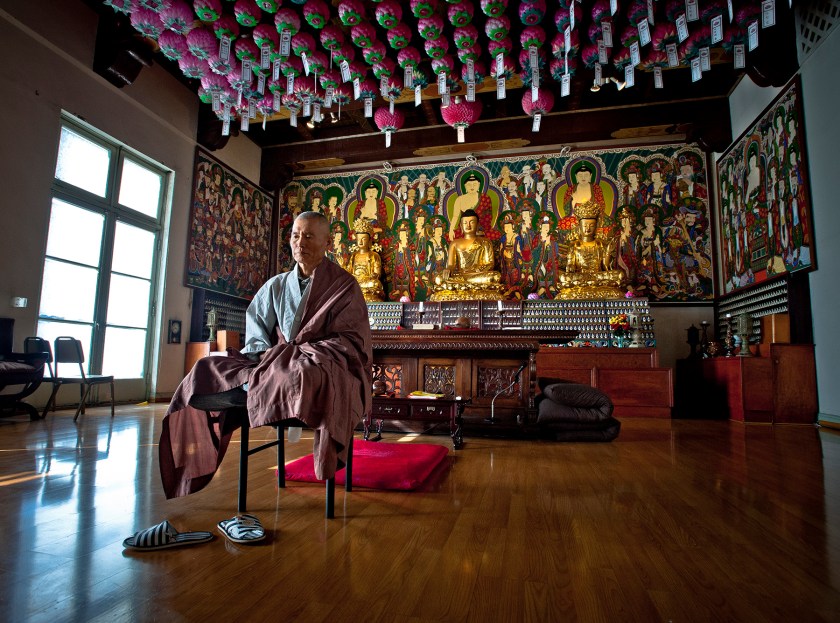
Meditation Master Daeryun of the Korean Buddhist Culture Center on Oxford Avenue and 3rd Street has taught meditation for 35 years and leads services at the center every Sunday as well as private services with individuals wanting meditation guidance. The Korean Budhist Culture Center was built in 1970.

Andy Choi was handing out flyers with friends from his church in front of the CGV shopping center near Wilshire Boulevard and Western Avenue. He is originally from Argentina but moved to the States when he was 16. He has lived in Koreatown since 2008 and made friends through his church group. His parents are both missionaries who moved to Argentina in the 80s to serve the church. Choi speaks fluent Spanish and Korean at a conversational level.

Stella has lived in Koreatown with her family for 18 years, moving from San Bernardino when she was two. Her father is a music teacher at Robert F. Kennedy High School and operated shops in the community prior to his teaching job. The biggest changes Stella had seen in the area were more foreigners from other parts of Los Angeles visiting the shops and restaurants. Her mother, Anna, said she felt the same way and many of those changes, she said, happened in the 80s. Stella added that the area has a similar look to South Korea but more in comparison to the countryside where it is more rundown, and there are more single story buildings . The larger cities in South Korea are more dominated by large buildings. The biggest change Stella said she would want to see is for more Korean Americans to get out of the bubble of Koreatown. Many of them become very comfortable there and don’t really feel the need to learn English. She added that she would also want to see more recreation centers to provide more activities for young people. She said kids don’t have anything to do so they spend most of their time at PC Bangs, Internet game cafes, where they will play PC games for hours. She said many young people will also go to the bars that don’t check I.D. cards. Anna said if she had enough money, she would build a multistory building with a cafe, swimming pool, and music hall to provide activities for young people. Other than cafes, Koreatown doesn’t have many establishments that provide those kinds of amenities

Younny was passing out flyers for her church on the corner of Olympic Boulevard and Western Avenue. She moved to Los Angeles in 1977 and currently lives in Pasadena but travels to Koreatown every week to go to church and see her daughter who lives there. She said its easy to live in Koreatown because it is familiar. She said since she had started visiting Koreatown, the biggest changes she had seen were more buildings and markets

Kenny is student attending Robert F. Kennedy High School. The biggest change he said he would want to see is an In & Out in the area.

Koreatown resident, Se Lee, on his way to work

Members of UCLA’s Hanoolimm Korean Cultural Awareness Group, from left to right, Patrick, Jin, Priscilla, and Justin. The group performed a traditional Korean dance called Poongmul throughout the 41st annual Korean Festival at Seoul International Park on the corner of Olympic Boulevard and Irolo Street

Pastor James Lee at the Oriental Mission Church on Western Avenue. “I don’t go to the adult service too much, but that could also speak to the fact that there’s a separation. I may not be able to see the distinction, but that’s because there’s a disconnect between what happens during the adult service and what happens in the youth service. We don’t know what’s going on in each other’s services.” Pastor Lee said the Korean community in Koreatown is still a new immigrant group, relative to the Japanese and Chinese communities. When the church first came to the U.S., it was a social center for Koreans, and for many residents in Koreatown, it still is. The church is where Koreans are able t be around other Koreans. “Koreans love to be around each other. We love social gatherings. We love to eat together. We love community,” he said.
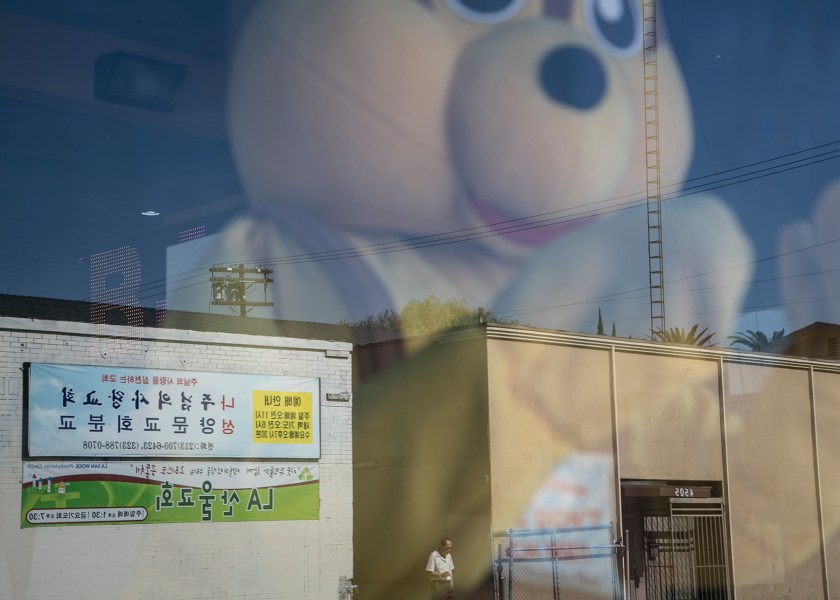
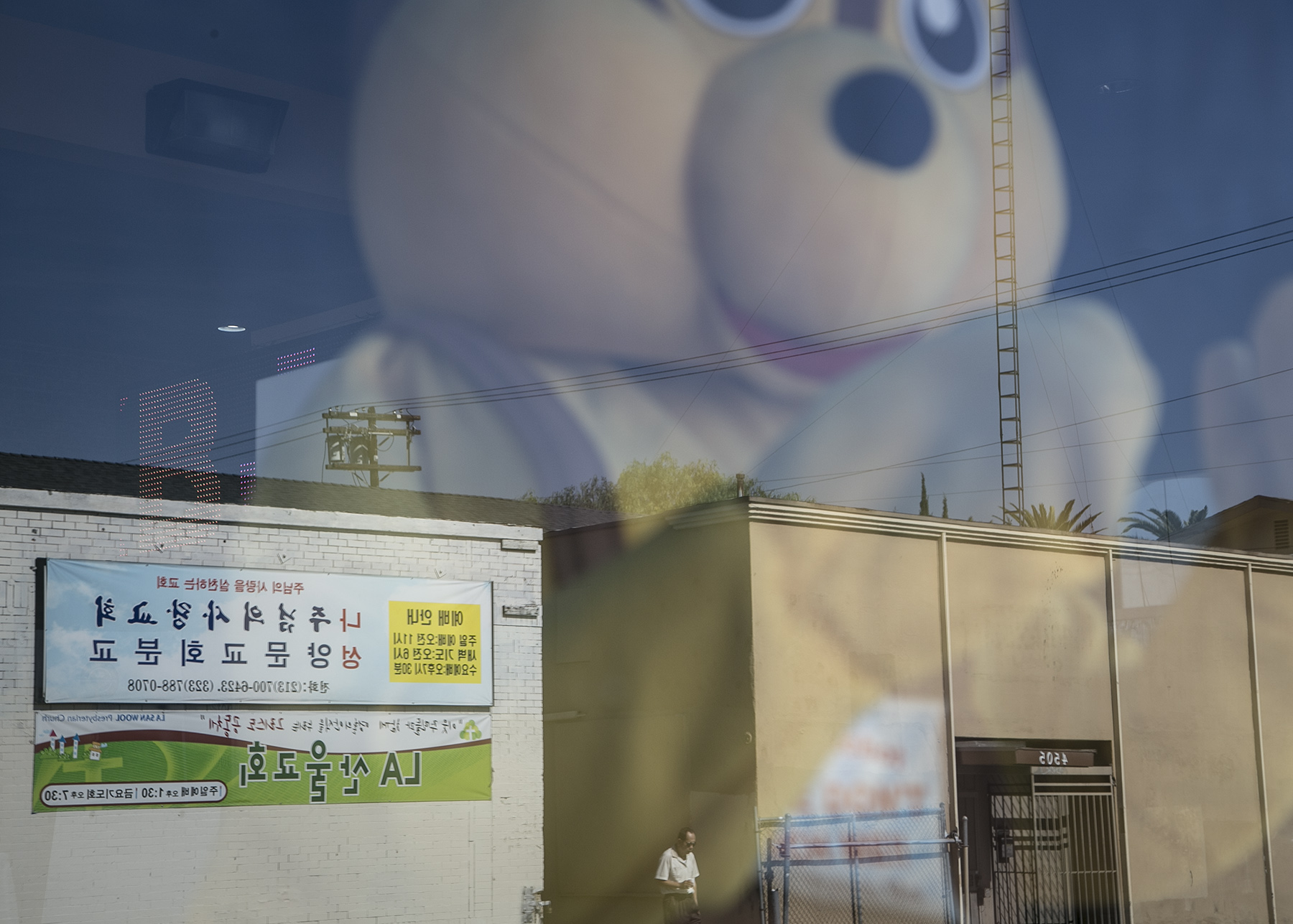
A storefront window reflects banners catering to Koreran speakers from across the street near 1st Street and Western Avenue

The Oriental Mission Church on Western Avenue and Rosewood Avenue is a multistory building. The adult services are conducted downstairs in Korean and the youth services are on higher floors, conducted in English. During lunch time everyone meets in the mess hall on the second floor to eat together

Students from Pastor James’ youth group at the Oriental Mission Church on Western Avenue say grace before having lunch at the Koreatown Plaza food court. Most of the group said they felt it was hard to find things for them to do in Koreatown, describing a distinction between the culture they know through the OMC and the culture of “K-towners”. “Pretty much the only thing to do in Koreatown is drink, and since we can’t do that, we go to karaoke bars. We don’t drink there, but we just sing. There’s a lot of pool halls with billiards. there’s a lot of dessert places. I think Koreatown is really well known for their deserts, ice-cream, and boba. None of us are really K-towners. I don’t want to be messed up or anything, but they’re not the same as us. They’re kind of ghetto. They kind of look like skaters, but they wear really skinny jeans, Nike shoes, a backwards hat kind of look. A lot of them smoke.”

The choir at the Oriental Mission Church leads the audience in hymnals during the adult service conducted in Korean. Services are separated by an English speaking youth group and a Korean adult service

Missionaries from several Christian denominations in Koreatown handed out literature and proselytized during the 41st annual Korean festival at Seoul International Park on the corner of Olympic Boulevard and Irolo Street. Signs and literature advertising church membership cater to Korean, Spanish, and English speakers

Local students complete a performance of a traditional pole dance during the 41st annual Koreatown parade along Olympic Boulevard. Performers use large sheets of colorful fabric tied to the top of a pole to create a variety of designs during a choreographed dance

Members of Hanoolim, a Korean cultural awareness group from UCLA, perform Poongmul, a traditional percussion performance that includes drumming, dancing, and singing Korean folk music, for vendors set up in shaded tents on the corner of Olympic Boulevard and Irolo Street for the 41st annual Korean Festival at Seoul International Park. Every year during the end of September, local and transnational vendors set up rows of tables to sell traditional Korean cuisine for visitors of the festival and residents of the community to try

Bystanders walk past a building displaying an ad for traditional Korean and modern wedding dresses near 6th Street and Western Avenue

Traditional Korean fashion on display at a clothing shop on Hobart Boulevard and Olympic Boulevard

Traditional Korean fashions on display at a storefront on 11th Street and Western Avenue

Modern Korean fashions on display at a storefront on Western Avenue and James M. Wood Boulevard

A clothing shop on Fedora Street shows modern fashion styles catering to Korean speakers
 CONTESTED SPACES