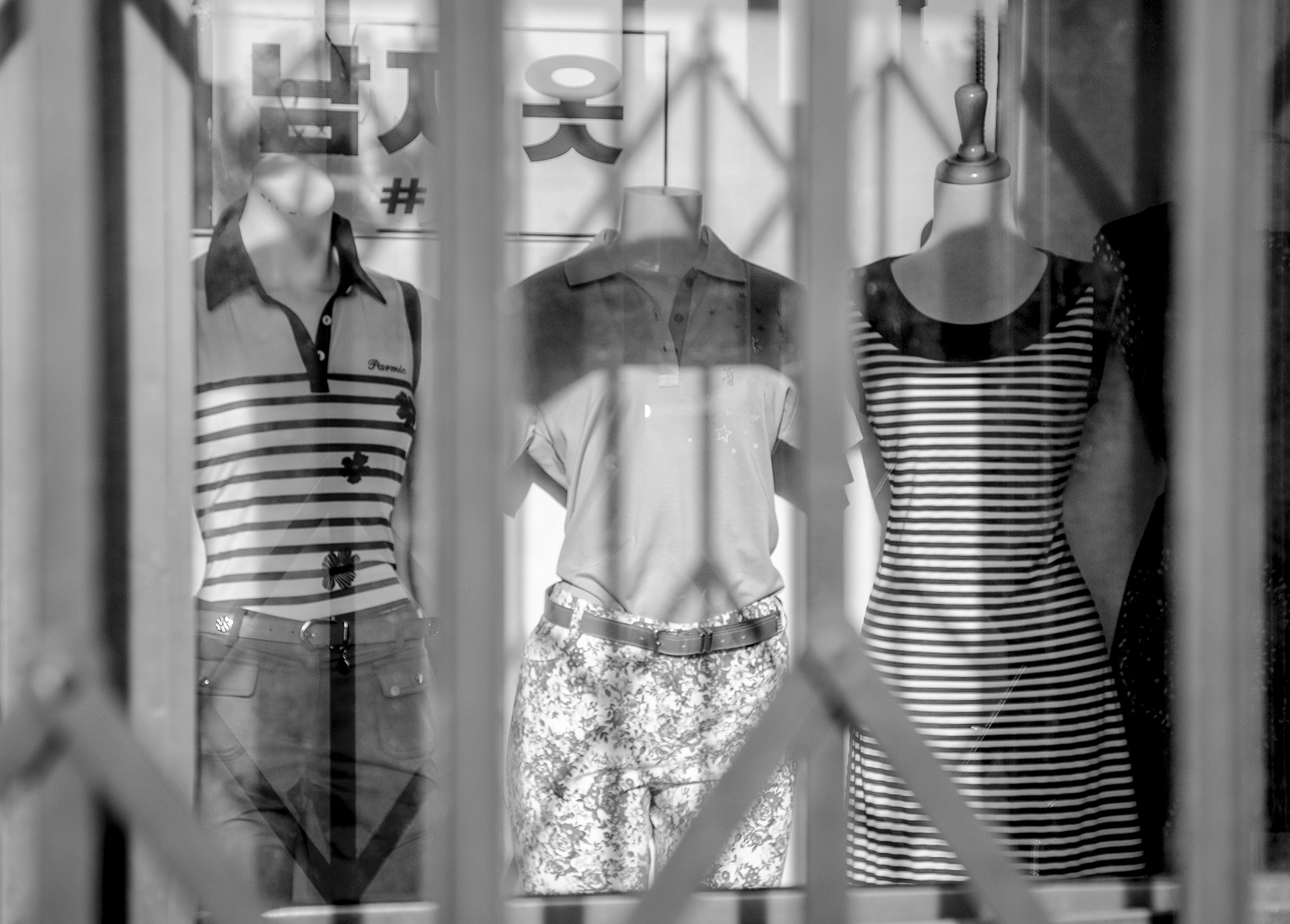
Modern Korean fashions on display at a storefront on Western Avenue and James M. Wood Boulevard
The static and lyrical modes of photography and the use of the survey approach represent the core methodology of this documentary style photo project. In a forward to Helen Levitt’s book A Way of Seeing, James Agee described both styles: the lyrical style refers to volatile images, those richest in emotion by subjects. Static photographs are “richest in meditativeness, in mentality, in attentiveness to the wonder of materials and of objects and in complex multiplicity of attitudes of perception” (Agee, 1965). The static and lyrical modes inform my visual approach to show the contrast between the three layers of cultures that co-exist in Koreatown: the historic, Korean American enclave; the transnational and regional center investment interests; and the multiethnic, local community composed of members from Central America, Mexico, and Bangladesh.
Most of the photographs I took were of buildings, storefronts, signs, advertisements, and people representing the various overlapping and juxtaposing cultures that reside in Koreatown. I made several trips over the course of three months walking through several of the major streets. My focus was specifically on the area of Koreatown in Los Angeles defined by its historic boundaries from Olympic Boulevard to the South where many of Koreatown’s oldest establishments still operate; Third Street to the North that welcomes a small Bengali community who share space with residents from Central America; Beverly Boulevard representing the official Northern border of Koreatown where mostly Central American businesses, markets, and papusa restaurants can be seen east of Alexandria Street up to the Metro Station; Western Avenue to the West where pedestrians can experience a wide variety of mixed use, mixed generation, Korean and Hispanic establishments; and Vermont Avenue to the East representing Koreatown’s eastern most border with both a historic Korean American presence and a Central American and community.
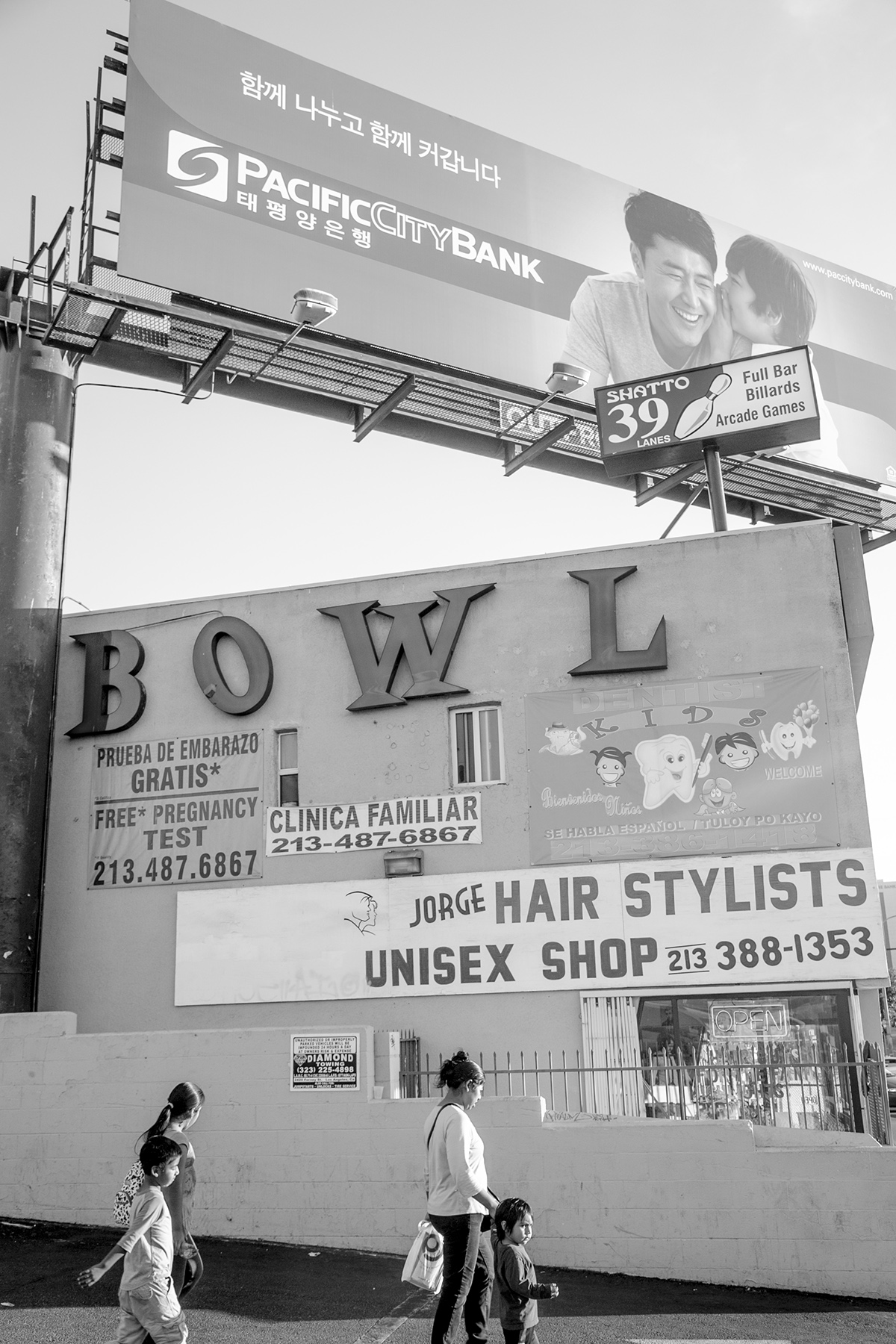
A bank billboard catering to Korean speakers is displayed over a bowling alley and mixed use shopping center catering to Spanish speakers near 4th Street and Vermont Avenue
I used the static mode to represent the various signs and advertisements that are displayed along several of Koreatown’s streets. Signs and advertisements show the contrast between the various multicultural and multiclass groups in Koreatown. Many of the signs I photographed were bilingual or trilingual catering to Koreatown’s diversity. Other signs and advertisements showed the diverse class groups who live together in the area. Some images I took of business establishments also follow the static approach. For these photographs, I wanted to show how certain cultures are juxtaposed with one another in some of Koreatown’s commercial areas. Additionally, I used the static approach to take portraits of the different people I met for the survey portion of my project. I took the majority of my portraits with a three quarter crop framing to show the articles of clothing they were wearing as well as some background details showing the environment.
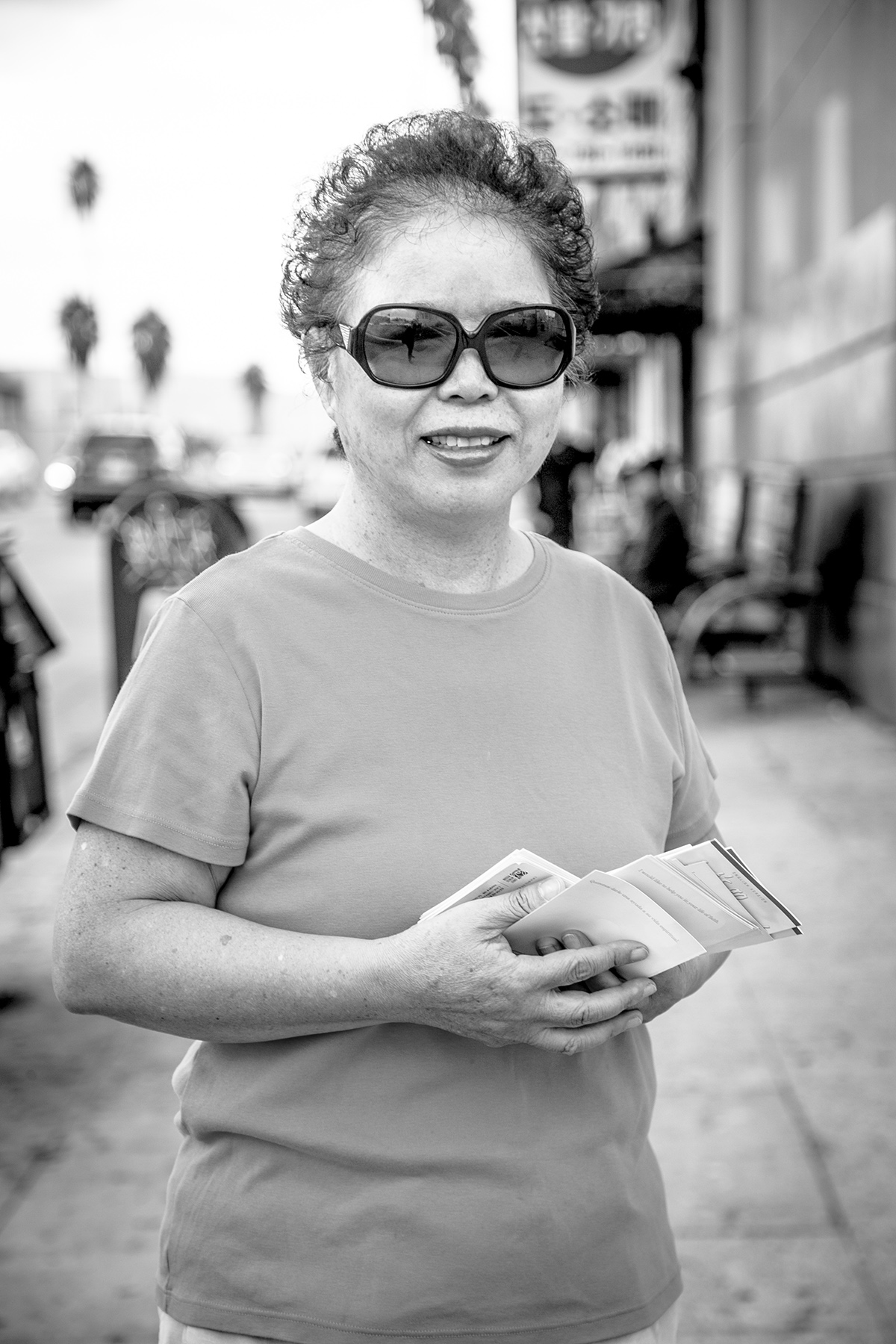
Younny was passing out flyers for her church on the corner of Olympic Boulevard and Western Avenue. She moved to Los Angeles in 1977 and currently lives in Pasadena but travels to Koreatown every week to go to church and see her daughter who lives there. She said its easy to live in Koreatown because it is familiar. She said since she had started visiting Koreatown, the biggest changes she had seen were more buildings and markets
Along with the portraits I photographed, I also asked survey questions: In what ways do the local, multicultural residents and workers experience Koreatown? What changes have they seen in their community for the past few decades? How do they perceive recent changes in Koreatown brought by transnational and regional investment? Most people were open to the idea of having their picture taken in exchange for a copy of it through email or a print I sent them in the mail. Approaching each person to ask for a portrait gave me the opportunity to explain what my project was about and to have a conversation about their experience living in Koreatown and their perception of the cultural and environmental changes to the area. Each of the interviews was informal lasting anywhere from 10 minutes to a half an hour producing a variety of responses. Language barrier was an issue for certain residents I approached who either declined my request for a portrait or gave a short response to my survey questions.
I used the lyrical mode to capture candid images of people on the move while walking through Koreatown. Street life is often vibrant depending on the time of the day. Each of the streets I chose are well populated and commercially dominant areas in Koreatown. During the day, people can be seen walking to school, work, church, or to visit friends or go shopping. In the evenings when nightlife establishments are open, more people can be seen walking to and from various bars and restaurants in the area. The three Metro Lines in Koreatown, one on Western Avenue with two on Vermont Avenue are usually always busy with foot traffic. These are major connecting points to other areas of Los Angeles transporting people to and from the area. Additionally, I had the opportunity to photograph Koreatown during the Korean Festival held each year at the Seoul International Park. This is a historically significant, cultural event that brings hundreds of people to the corner of Olympic Boulevard and Normandie Avenue to visit rows of food and product vendors, see K-pop and Korean traditional performers on a large stage, and watch the parade that travels from Vermont Avenue to just short of Western Avenue on Olympic Boulevard.
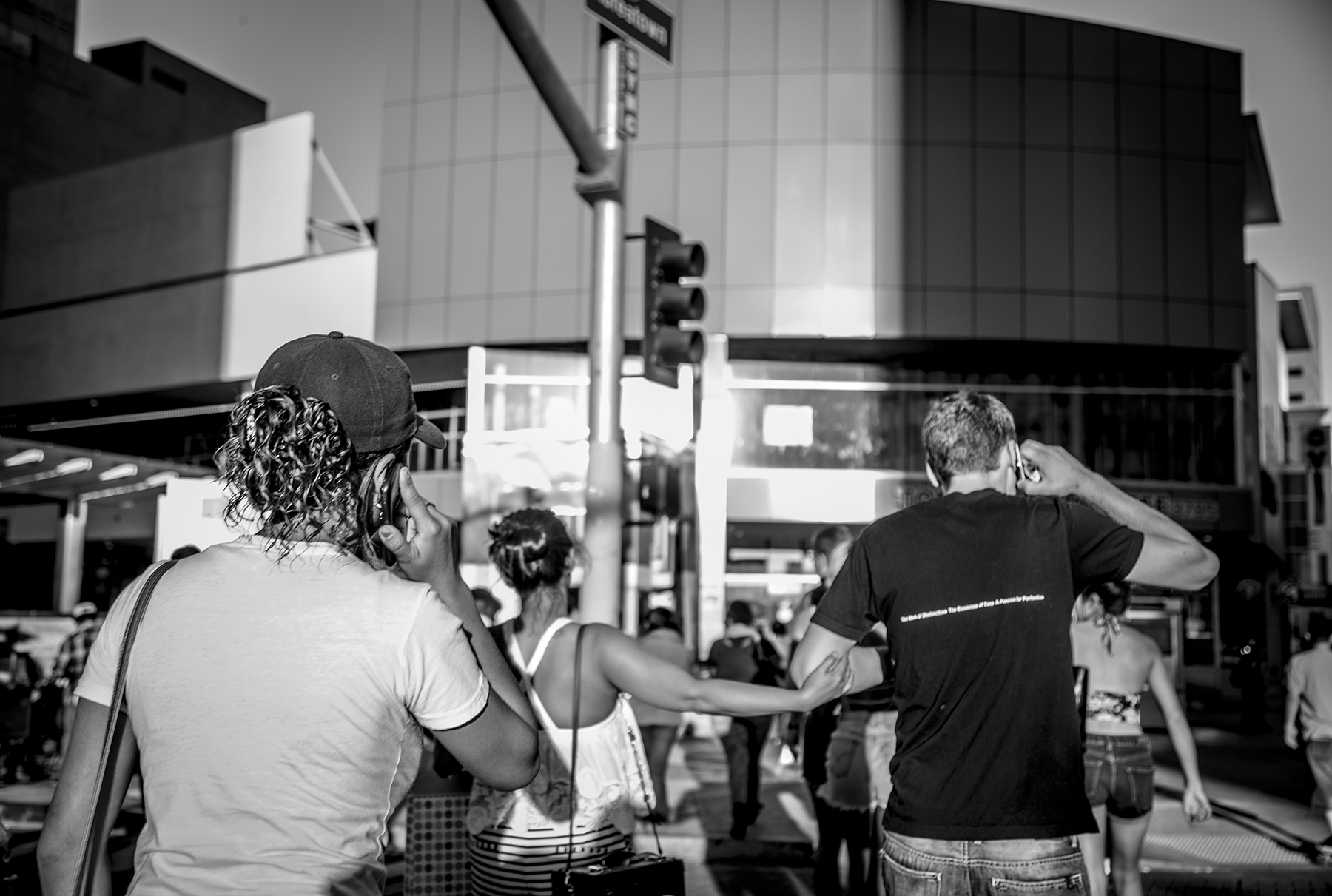
Bystanders cross the street leading to the Metro Station on Western Avenue and Wilshire Boulevard
Most of my visits occurred between the middle of September to the end of November giving me about three months to photograph and meet people there. I took nearly 3,000 images during this period, which I had edited down to about 100 images presented on a photo gallery website. I traveled to Koreatown on average three to four times a week to walk through the various streets, attend events, and visit the various shops, restaurants and religious institutions, making multiple trips to each street throughout that period. The streets I chose were regularly busy, usually during the later parts of the day because they are commercial areas lined with storefronts, establishments, and people walking to and from various locations.
The equipment I used consisted of a Canon 6D DSLR camera and a 24-105mm lens capable of taking both wide angle cityscapes and tight portrait photographs and a pen and notepad to record the responses of each of the people I met following our interviews. I edited each of the photos on my laptop using Photoshop. I edited the photos in a combination of color and black and white images. I chose to edit most the static images in black and white to emphasize the textual elements and eliminate the color elements that do not contribute to the overall meaning of the photograph. I kept certain images in color where color played a role in showing the culture.
 CONTESTED SPACES