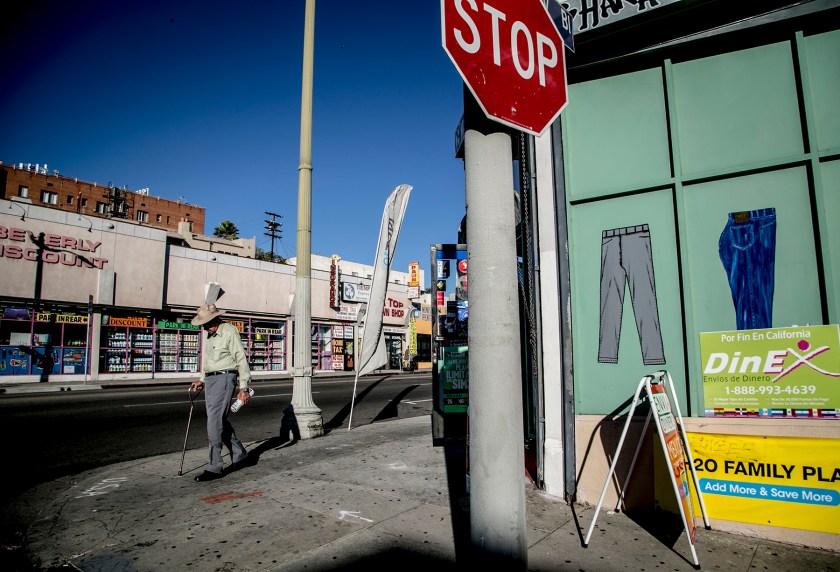
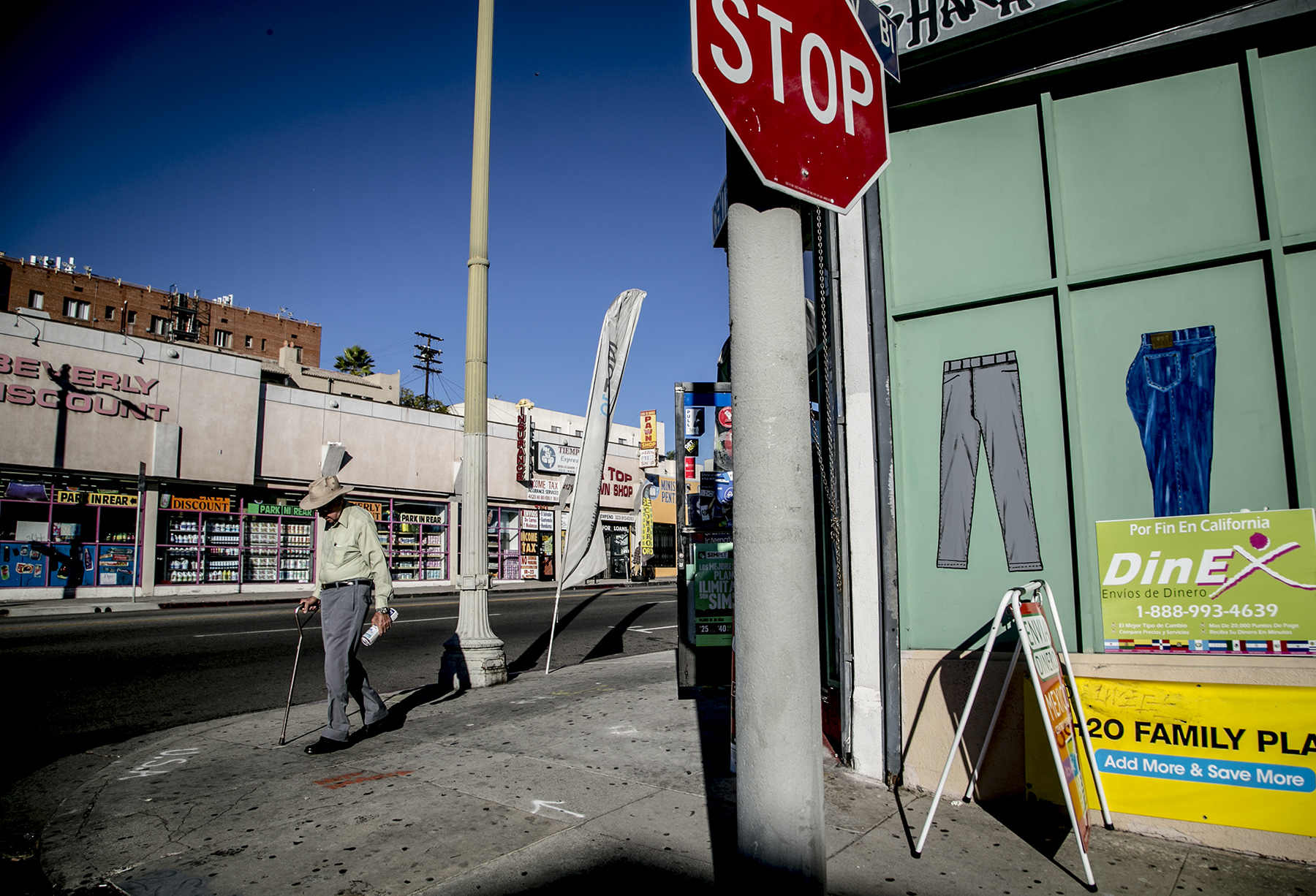
The corner of Mariposa Street and Beverly Boulevard shows a wide variety of services that cater to the Spanish speaking community including remittance services, a mobile store that provides pre-paid phone cards to communicate back home, an El Salvadorian market, and two general stores.
My aim for this section was to show the various ethnic groups who live and work in Koreatown. I wanted to provide the view that Koreatown represented a diverse population showing the establishments, advertisements, and a broad cross section of people who live in the area. Most of the images I used for this section were taken on 3rd Street, Vermont Avenue, Western Avenue, and a small area of Olympic Boulevard showing a popular Oaxacan restaurant that was once a prominent Korean establishment.
The 1980s marked Koreatown’s dramatic transformation to becoming a multicultural space. During this period, a large influx of Central Americans, Mexican Americans, and Bengali Americans began to move in to the area. These groups were present in Koreatown earlier, since the late 60s, but particularly with the Hispanic community, civil wars drove many Central Americans to come to the United States while economic instability drove many Mexican Americans to move. For someone unfamiliar, it is easy to believe Koreatown is a solely Korean space. However, Koreatown is actually a majority Hispanic population. Additionally, small pockets of other ethnic communities are present as well. There is a small Bengali designation on 3rd Street called Little Bangladesh, and on Vermont Avenue between Beverly Boulevard and 3rd Street, there is a small Filipino community with two grocery stores and a handful of restaurants.
When I thought about how to photograph signs that represent Koreatown’s multiculturalism, I thought about juxtaposition, both within the elements I captured in my images as well as the way I wanted to present them. Many communities overlap and are in close proximity to one another. For example, Most of the people who live in or near Little Bangladesh are actually from Central America. There are only about a dozen Bengali establishments there. Signs, placards, and advertisements are common themes found in Koreatown, and some of the images I chose show different ethnic signs juxtaposed in close proximity to one another. One image, for example, shows a large billboard advertising a Spanish soap opera displayed above a sign for a Vietnamese restaurant. Other advertisements are trilingual catering to Hispanic, Korean, and English speakers.
When deciding on the presentation, I thought about Robert Frank and how he composed The Americans, a thematic series of recurring symbols, the car for example set in various circumstances at one level a vehicle for people’s first sexual encounters, at another level, a symbol of isolation. My intentions for this section are neither about symbolism nor misanthropy. However, Frank showed that the juxtaposition of images can make a statement. I wanted to show the multiculturalism of Koreatown through the juxtaposition of different signs and establishments that represent the wide cultural spectrum of Koreatown’s population, and as they are physically close in proximity within Koreatown’s historic boundaries, I wanted to represent them as physically close in proximity within the gallery.
The portraits follow a static approach, most similar to the portraits I present in the ethnic enclave gallery: medium tight, three quarter shots showing some environmental elements in a portrait framing. I thought about Hine’s approach to surveys, the role of the photographer as a survey investigator, collecting a small and random sampling of Koreatown’s population. I met a wide spectrum of people when I was searching for portraits. Most of them were from Central America. I found most of the Hispanic people I met were very welcoming, easy to approach and open to the idea of having a portrait taken as well as a conversation, especially about the changes they wanted to see in Koreatown, additionally, welcoming the idea of me sending them a copy of the portrait I took. Many people I spoke with expressed that Koreatown needed more jobs available for people as well as smaller issues like more parking or repairing the sidewalks, but they weren’t unhappy living there. Several people expressed they were happy to be in a place that was both diverse and close to their cultures of origin.

A large mural showing a map of Central America alongside advertisements aimed toward Mexican Americans are displayed on the building of a barber shop on the corner of Edgemont Street and Beverly Boulevard.

A mural on Alexandra Street indicating the Bangladeshi community on 3d Street

Business signs on San Marino Street catering mostly to Korean speakers. Behind it is billboard advertising Direct TV catering to Spanish speakers

A business sign catering to Korean and Spanish speakers near San Marino Street and Vermont Avenue

A sign displayed on the window of a hair salon on Catalina Boulevard and 3rd Street welcomes Spanish speakers

The city placard welcoming drivers to Little Bangladesh on 3rd Street and Alexandria Street

A billboard for a Mexican Telenovela displayed above a Vietnamese restaurant near Oakwood Avenue and Western Avenue
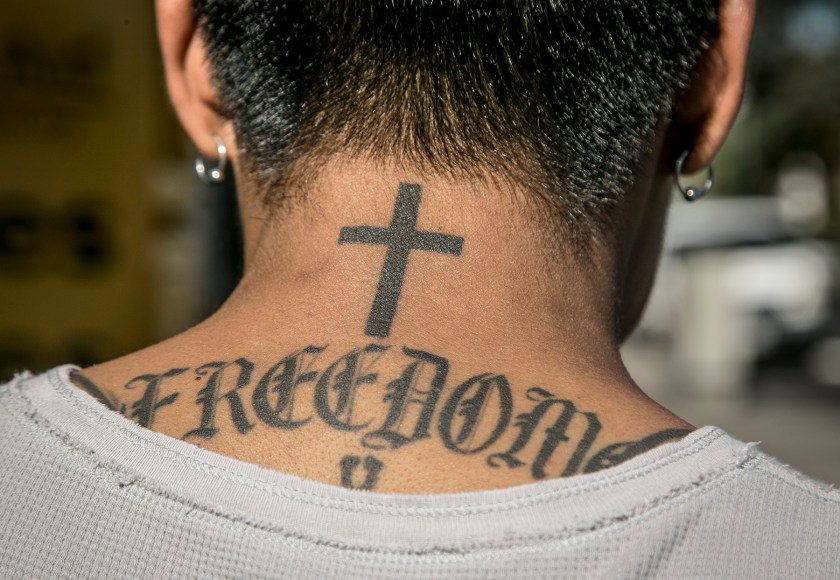
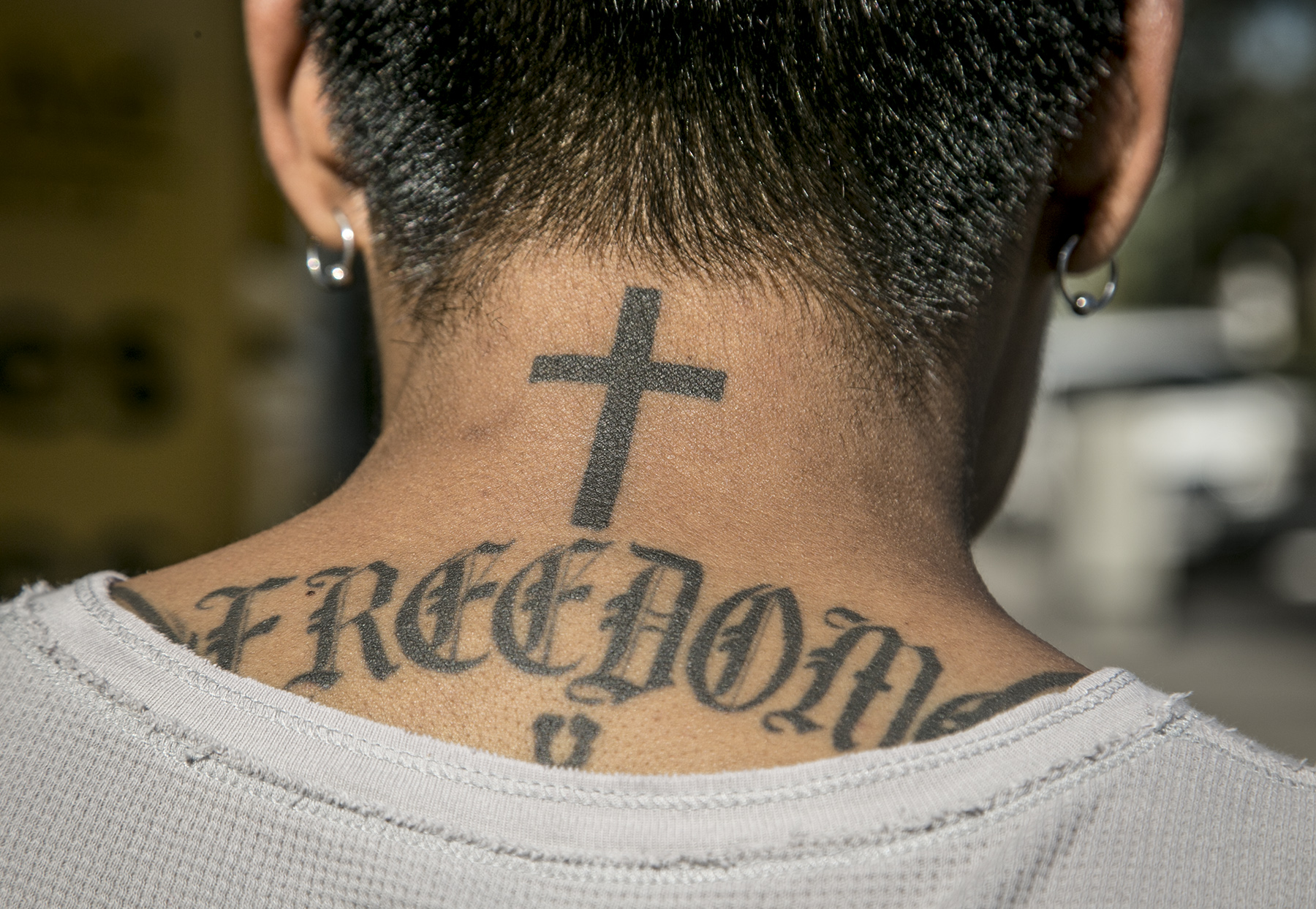
Xavier moved to Los Angeles 10 years ago from Mexico. He’s lived in Koreatown for 8 years. He said the biggest changes he said he had seen were more Latinos. On 3rd Street where he gets his hair cut, he said most of the Latinos there are from El Salvador, so people walking by will see many papusa restaurants. He said he wouldn’t change anything about the area, and that it’s perfect as it is. The police provide security for people there. His tattoo represents what he wants: to feel free to be whoever he wants to be, unlike how he felt when he was living in Mexico

Willy is from El Salvador. He said he just likes the hat

Martha and her granddaughters (from foreground to background), Tatalina, Esther, and Martha. They are from El Salvador

Nelson and Nelson Jr. are from El Salvador. He’s lived in Koreatown for 10 years and said the biggest change he would want to see is more work for people

Benji was born and raised in Boyle Heights. His family is Salvadorian and Mexican American. He’s been travelling to Koreatown for the past 30 years to visit his friends. The biggest change he said he had seen was more diversity and more people willing to step outside of their comfort zone to meet people who are different. When he was growing up, he said ethnic groups were more isolated to their own areas. The biggest change he said he would like to see were more jobs for people. He said employers in the area know many immigrants are looking for work, so they’re easily exploited

Jorge (center) has lived in Koreatown for 18 years. The biggest change he said he had seen was that the area has become nicer. The city fixed more of the roads. He said it’s also become safer. There used to be more gangs who would hang out around 3rd Street, but the police chased them out of the area. He said there is still one gang who’s responsible for a lot for the tagging seen around the area, the 18th Street Gang. The one thing he and his friends said they feel the area needs are more parks. There’s only one park that’s close to them, Shatto Park on 4th Street and Vermont Avenue, but the 18th Street Gang members hang out there and rob people. They said it’s not a safe place to be

Soko and Temka are Koreatown residents from Mongolia

Pauline has lived in Koreatown on and off for 10 years. She currently lives in a neighborhood on Normandie Avenue and Wilshire Boulevard. She said the biggest changes she had seen were more shops and markets and older ones being renovated. One of the biggest issues that affects her are slum lords who knowingly rent out apartments that have problems. She said people leave their furniture out on the street because of bed bugs and the problem spreads out to other houses. Slum lords don’t call exterminators to spray or tent the buildings so the problem doesn’t get resolved.

Letti and Alex are from Guatemala. They sell oranges at two locations on 3rd Street every Saturday and Monday

Carlos Ramirez (left) lives in the Valley but travels to Koreatown weekly to hang out with his two friends Destiny and Carlos. He said he likes the area because he feels people are more welcoming whatever their ethnicity is. Destiny has lived in Koreatown for one year and Carlos Villalta (right) has lived their for two years

Xochitl and Ernesto grew up in Koreatown and go to high school together. Ernesto’s grandfather moved to the area from Mexico to raise his family. Ernesto said many people are nice here and share a common language. He added that many places he likes are walking distance from where he lives like arcades, pool halls, and the House of Blues further down Western Avenue on Sunset Boulevard

Manjivar moved to Downey two months ago from El Salvador but visits Koreatown every week to see his friends. He works at an Italian restaurant in Bell Air. He said it’s difficult to meet people because he doesn’t speak English well yet.

Yibhan has lived in Koreatown for 12 years. He commutes by bike from his home on Mariposa Street and Olympic Boulevard to his work on Fairfax Avenue. The biggest changes he said he had seen were more luxury apartments and businesses especially along Vermont Avenue and Wilshire Boulevard. He said he feels some concern that the luxury buildings will soon drive the price up on rent. He said he had also noticed price increases for food at some of the markets he would go to

Stephanie and Danny are both Los Angeles City College students. They both grew up and went to school in Koreatown. The biggest change Stephanie said she has seen are more Hispanics. She said many of them used to live in Echo Park but recently they’ve been moving to Koreatown,. Danny said he likes all of the New Buildings along Western Avenue because they look nice, and a lot of the establishments there provide things to do for young people in the area. Stephanie said she liked how diverse Koreatown has become and said she wouldn’t make any changes to the area. Danny said one thing he would want to improve was to fix the cracks on the sidewalks.

Sam and Reina are Koreatown residents. Sam is the lead singer of a Cumbia band and has performed at the Guelaguetza for four years. Reina manages the band. He said the other members of the band are from various areas of Central America, El Salvador, Guatemala, and Mexico. Sam got his degree in culinary arts and worked as a chef at a Korean barbecue restaurant before starting the band and said for him, food has been a way to open the door to know other cultures
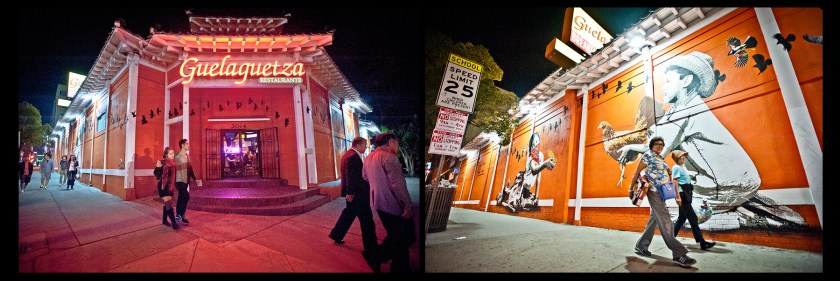
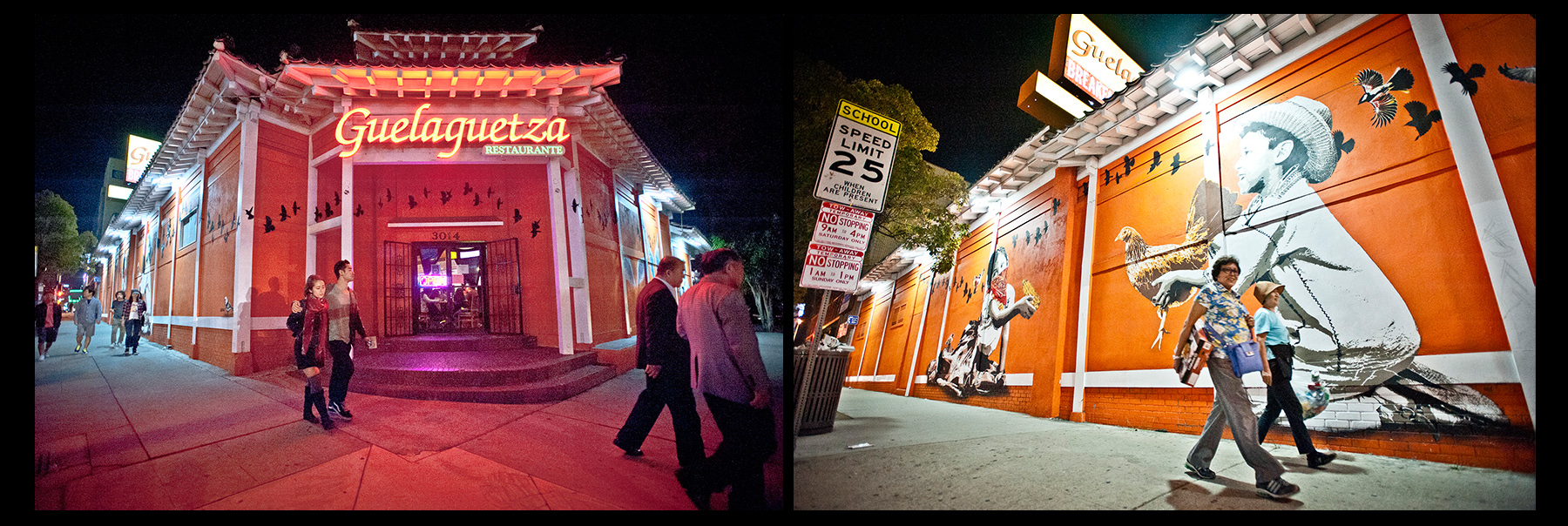
The Guelaguetza is a traditional Oaxacan restaurant on the corner of Olympic Boulevard and Irolo Street. The restaurant features traditional Korean architecture, the remnants of Hi-Duk Lee’s VIP Palace, which once welcomed various dignitaries from Los Angeles. By the 90s, most of the business interest left Olympic Boulevard and began to move towards the Wilshire and Western areas of Koreatown, and in 1994, Fernando Lopez, a Mexican American immigrant, opened the Guelaguetza keeping the architecture of the closed down VIP Palace. The area south of Olympic Boulevard is home to a large Zapotecos community, Oaxacans from Sierra Juarez who have had a place to taste their home cuisine for the past 20 years.

A bank billboard catering to Korean speakers is displayed over a bowling alley and mixed use shopping center catering to Spanish speakers near 4th Street and Vermont Avenue

Spanish language specific signs are displayed on a mixed use building, housing an Oaxacan grocery store on the corner of New Hampshire Avenue and Beverly Boulevard.

A mixed use building on the corner of Ardmore Avenue and Beverly Boulevard shows an establishment aimed towards Korean speakers that is no longer in business and a Papusa restaurant . Papusas are a popular dish from El Salvador

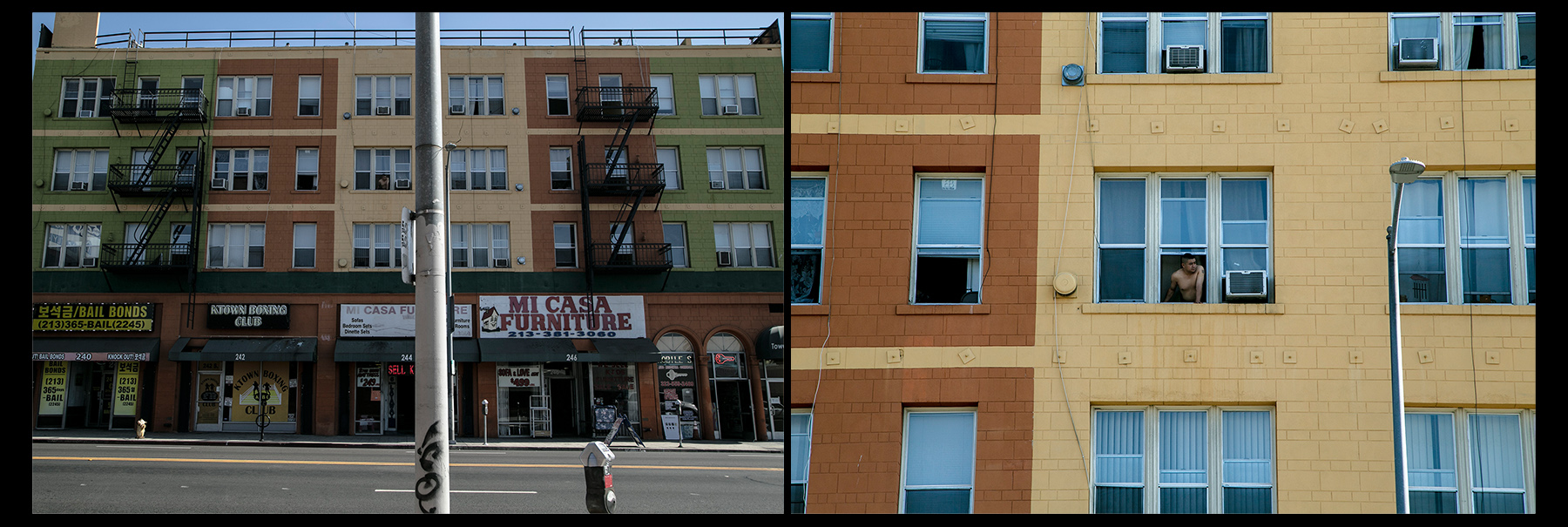
A mixed use building shows businesses catering to both Korean and Bengali speakers

Bystanders walk past one of several Bangladeshi shops located on 3rd Street in Koreatown in a small designation called Little Bangladesh. Additionally, establishments catering to the Central American population can be seen sharing the area as well
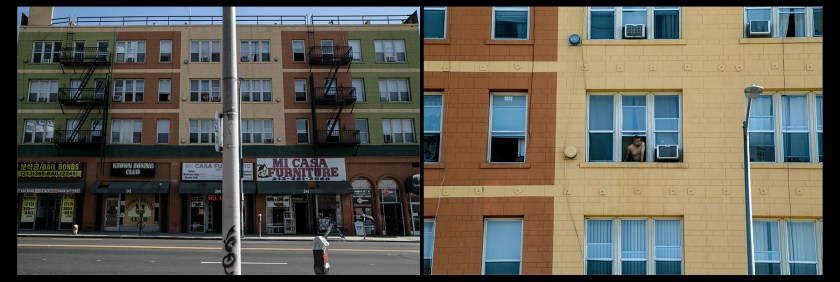
A mixed use building near 2nd Street shows an apartment complex connected above businesses catering to both Korean and Spanish speakers

Jollibee is a popular fast food chain based in the Philippines located on the corner of New Hampshire Avenue and Beverly Boulevard

A Filipino grocery store on 3rd Street and Vermont Avenue

A Filipino bakery and fast food restaurant on 3rd Street and Vermont Avenue

A Filipino grocery store on 2nd Street and Vermont Avenue
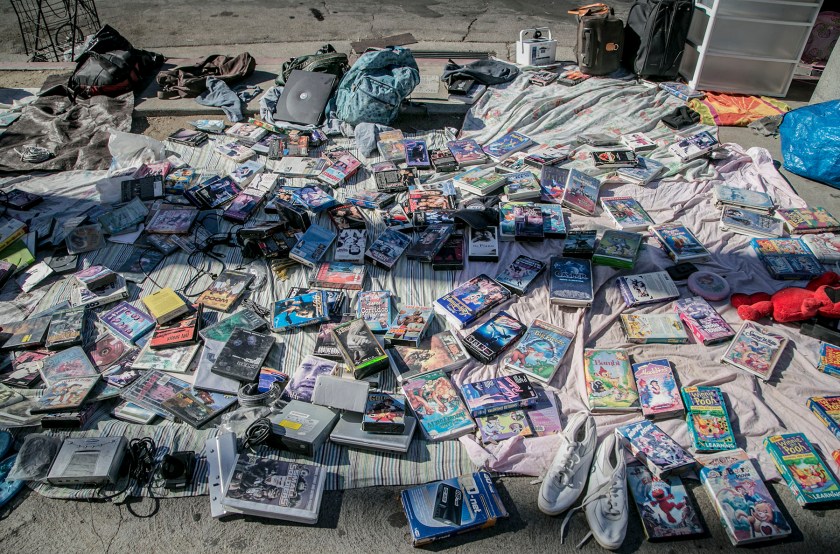
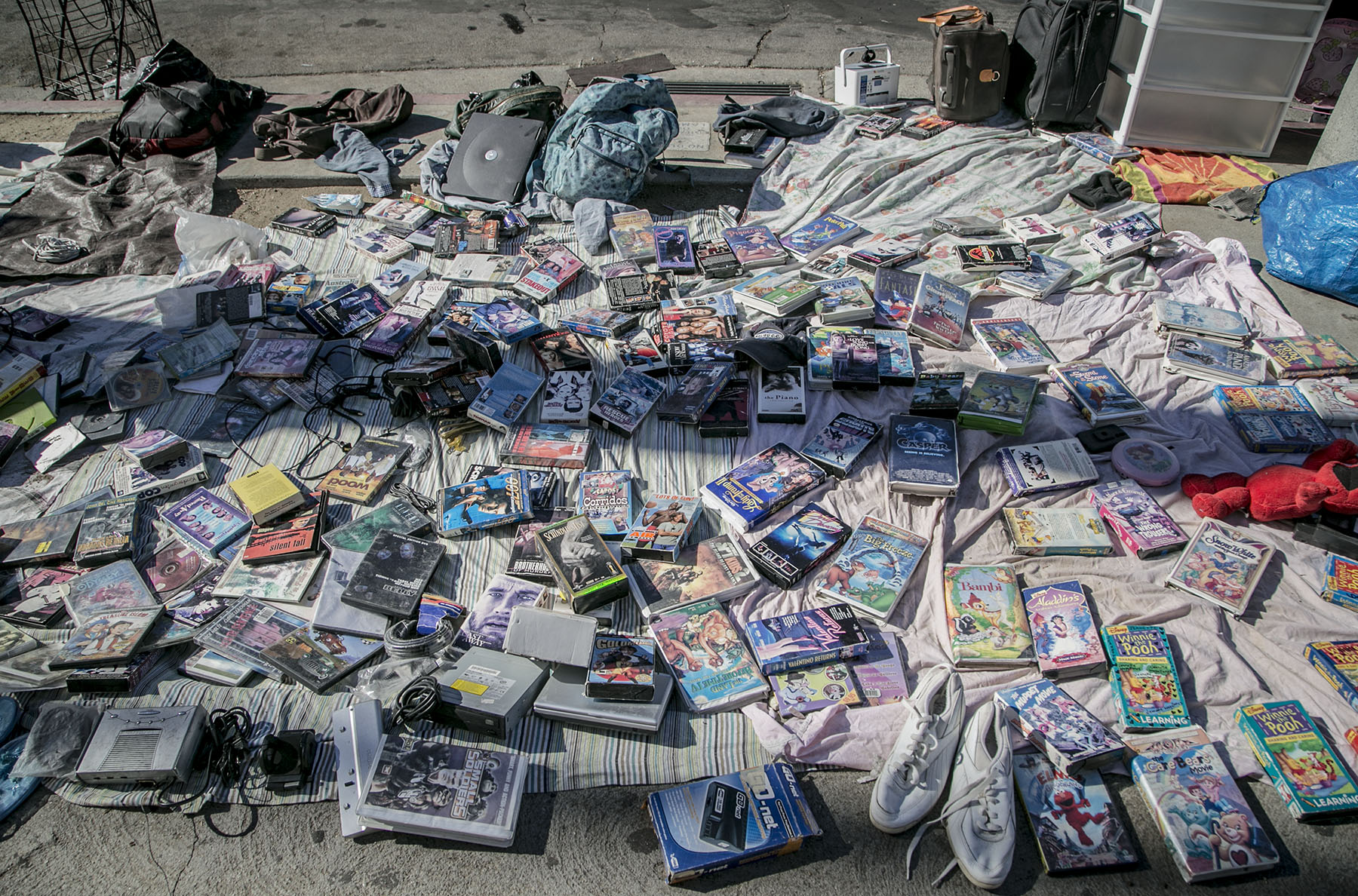
VHS tapes for sale at a swap meet on Kenmore Avenue and 3rd Street in the Little Bangladesh designation in Koreatown. There is a mix of Bengalis and Central Americans who live in the area
 CONTESTED SPACES