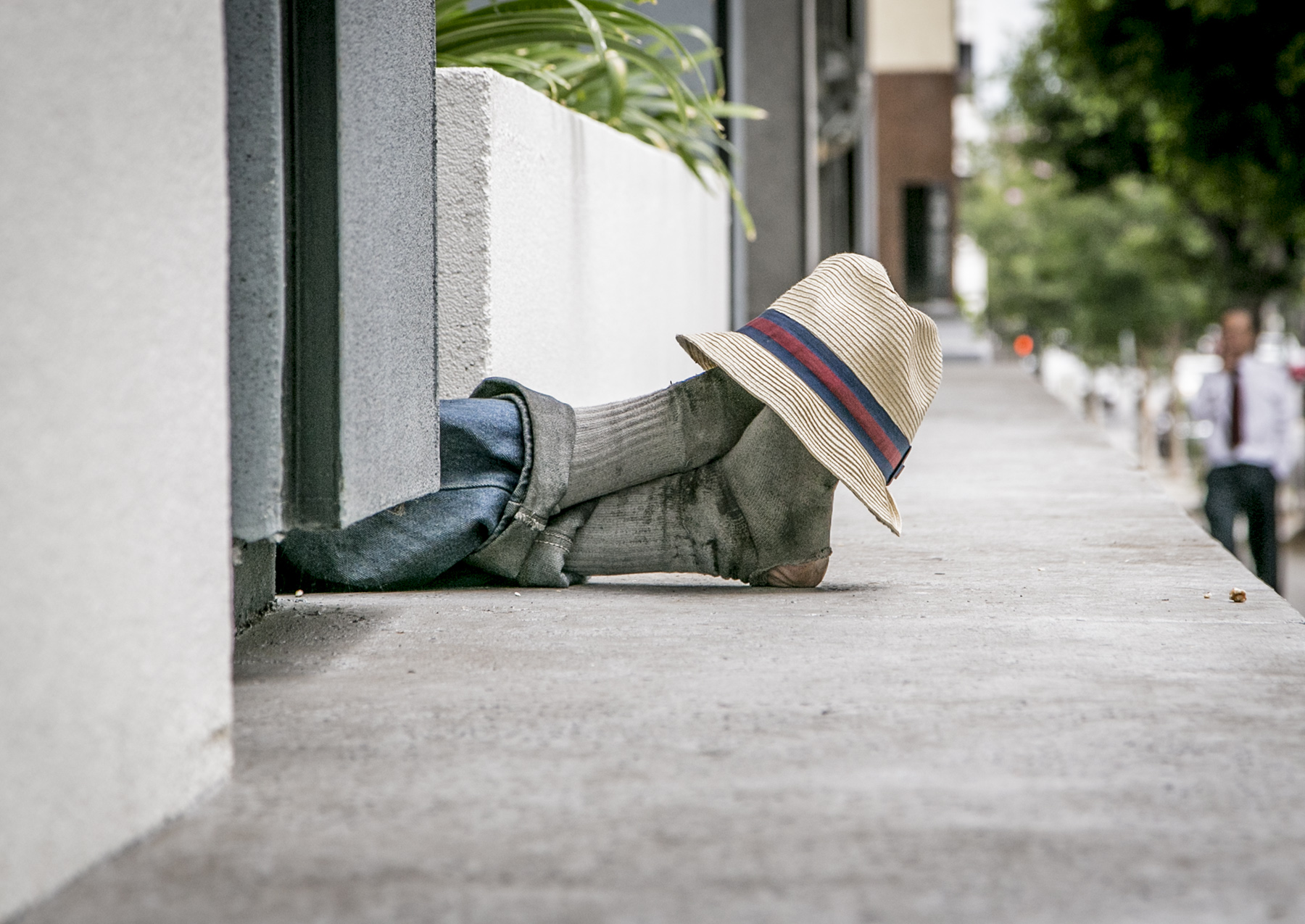
A homeless man extends his feet while napping along the side of a building on New Hampshire Avenue and Wilshire Boulevard, part of the the area’s financial sector. The image captures the theme of Koreatown’s class differences: a man’s feet in haggard socks are veiled by a stylish fedora, a symbol for a veiled subsection of the area’s population that lives in poverty but remains unseen and unrepresented.
The images in this section show more of the recent additions to Koreatown’s environment. My aim was to show images that represented Koreatown’s multiple class groups as well as the qualities that make the area a transnational and regional center. Many of the photographs I include portray newer buildings. I also wanted to show that there was a cross section of people who lived in poverty as this is an issue that is inadequately addressed. Most of the images for this section were taken along Wilshire Boulevard and some areas on Western Avenue and Vermont Avenue nearest to the Metro Lines.
In 1995, the City of Los Angeles created the Wilshire Center / Koreatown Redevelopment project area, a general planning framework to designate Koreatown as a regional center – meaning an area with an emphasis on regional commerce with the hope of attracting more regional developers and transnational investment. The plan followed from the 1992 Los Angeles riots. Many of the establishments in Koreatown and along Wilshire Boulevard were targeted during the rioting. Although, it took nearly a decade for developers to rebuild from the damage, redefining the area as a regional center was the catalyst for many of the transformations residents see in Koreatown today. The redevelopment plan included the opening of three Metro Line stops, the adoption of district ordinances that would provide incentives for developers to build affordable housing near the transit lines, and major development plans particularly for the areas of Western Avenue, Vermont Avenue, and Wilshire Boulevard.
Many of these changes were the catalyst for further transnational investment and development. By 2000, more Korean immigrants began to arrive under the provisions of “employment based preferences”, but now, most Korean transnationals arrive as investors. Between 2000 and 2010, Korean American investors acquired 3.5 million square feet of commercial property along Mid-Wilshire including nine California chartered Korean banks with assets totaling $9 billion according to 2008 estimates.
I photographed several bank buildings along Wilshire Boulevard during various times of the day, but usually during the late afternoon when the setting sun begins to cast long shadows on to the cityscapes. I thought of Atget and Szarkowski in my approach to photographing some of the high rises. Several of the buildings Atget photographed in old Paris were isolated from other elements such as bystanders or vehicles and shot with an emphasis on tone and mood that delivers a feeling of reflection on the subject. Szarkowski photographed several barns and farmlands throughout the United States. Many of his images are shot at the wide to medium focal length, few with people, emphasizing a contemplative serenity of, for example, the way a tree looks walking out of a barn and how the textures and light contrast between differing exposures within the frame.
Similar to their styles, I shot most of my high rises and cityscapes from the ground level or an elevated platform with a wide to medium focal length. There are several high rises along the Wilshire Boulevard corridor, some lording over the city. For some of the buildings, I wanted to show the scale of some of the new developments. I show the Vermont condominium complex, for example, towering over many of the buildings behind it vanishing into the horizon line. My second image shows a tightly composed dyptic of three Korean banks, one shot at night and the other shot during the late afternoon. I chose them because I felt the tone of the dyptic provided a contemplative feel about the environment.
Most of the people I took portraits of were commuters who either lived in Koreatown and worked somewhere else or lived somewhere else and worked in Koreatown. I shot most of the portraits with a tight, three quarter portrait framing, showing details of their attire and some details of environment in the background. Many of the people I spoke with chose the area because of its access to Metro Lines, its proximity to other areas in Los Angeles, and the diversity of cultures that make up the population, which, several expressed, were attractive qualities about the area. These portraits reflect Koreatown’s regional appeal.
Others I met were transnationals. One man I met on 3rd Street was from Bangladesh. He explained that he was educated in his home country as an engineer and came to the United States to find a job in his field. He had been living in the States for 6 months but was struggling to find an engineering job. In the meantime, he works at a Bengali corner store market to make some money while he waits for a position to open. His experience is similar to many of the early Korean settlers who also received advanced degrees in Korea but ended up working in independent businesses in the enclave because they couldn’t find work in their fields.
Another transnational person I met was a Korean college student from a university in Jin Ju, South Korea during the 40th annual Korean Festival held each year at Seoul International Park. Each year, the park sets up rows of booths along Irolo Street and Normandie Avenue where local and transnational vendors can sell various food items during the four day event held during the end of September. The student who I met was with two classmates participating in a business incubation program, a school program where students studying marketing and business can travel to another country to practice selling products to an overseas market. At the end of the term, the students travel again to an exhibition where they share with their peers what they learned about salesmanship.
Additionally, I included static images of some of the signs displayed near the regional development areas, representing them in a tightly framed format to emphasize the layers of text. One image shows billboards advertising two of the prominent banks in Koreatown displayed above a gas station. Below the billboards is a sign welcoming EBT recipients. The image shows two layers of Koreatown’s multiclass population physically presented in close proximity.
A few of the images portray some of the homeless who live in Koreatown. My opening image shows a homeless man extending his feet while napping along the side of a building. His socks are worn and covering his feet is a fedora. I felt the image was a good representation about the class differences that are present in Koreatown. Despite most of the redevelopment and transnational investment that goes on there, the response to poverty has been slow. 2010 census data reports the average income of residents is about one half of the average of Los Angeles at just over $30,000 a year. Data collected by the Korean Youth and Community Center’s free tax preparation program show some residents who earn about a third less than that. I wanted to juxtapose some images of the homeless community alongside the context of the transnational investment and regional development that’s occuring in Koreatown.
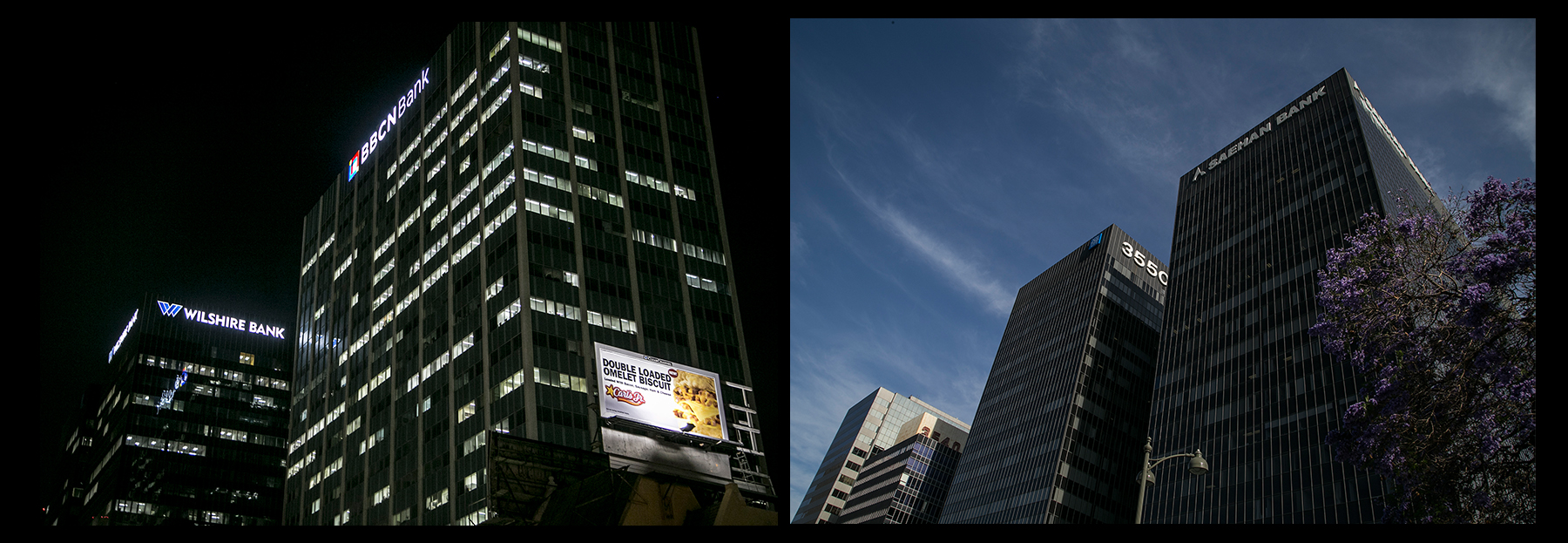
High rise buildings house three large Korean banks: BBCN, Saehan, and Wilshire Bank along Wilshire Boulevard


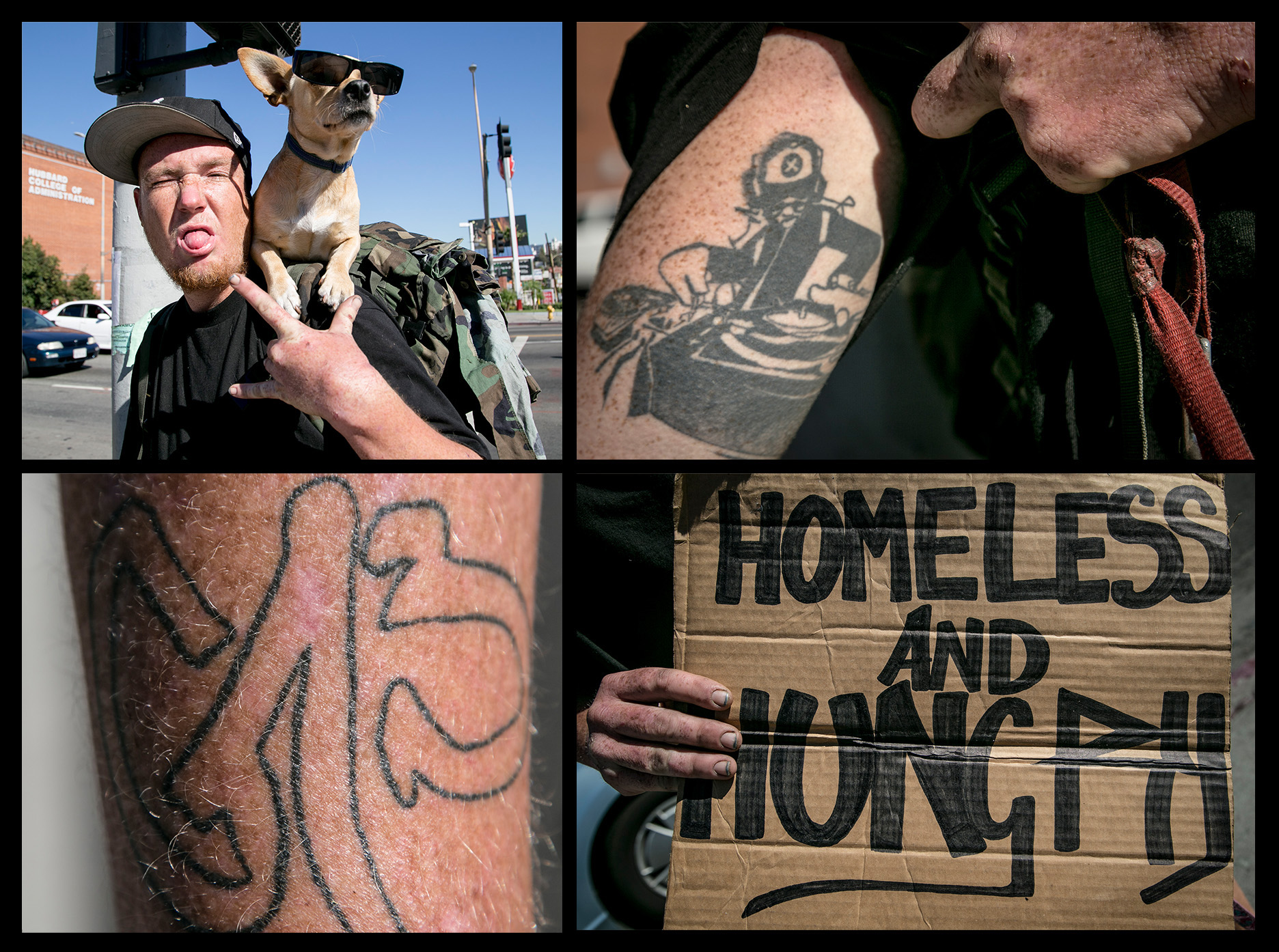
“I can’t get a job. I don’t have a cell phone or anything. You need to be able to take a shower and have clean clothes to have a job.” Matthew arrived to Los Angeles four years ago from Phoenix, Arizona. Prior to living on the streets, he was a DJ. His mother had passed way two years ago and his only family is his two dogs. He sleeps at MacArthur Park, a few Metro stops east of Koreatown. He said the police don’t bother him about keeping a tent out there. From Monday through Friday, he travels to where Rampart District borders Koreatown on Beverly Boulevard and Vermont Avenue. He said the police don’t bother him about panhandling there, and they’re nice to him. He’s tried panhandling in Hollywood but said the police don’t tolerate the homeless there saying they even shut down some of the food pantries.


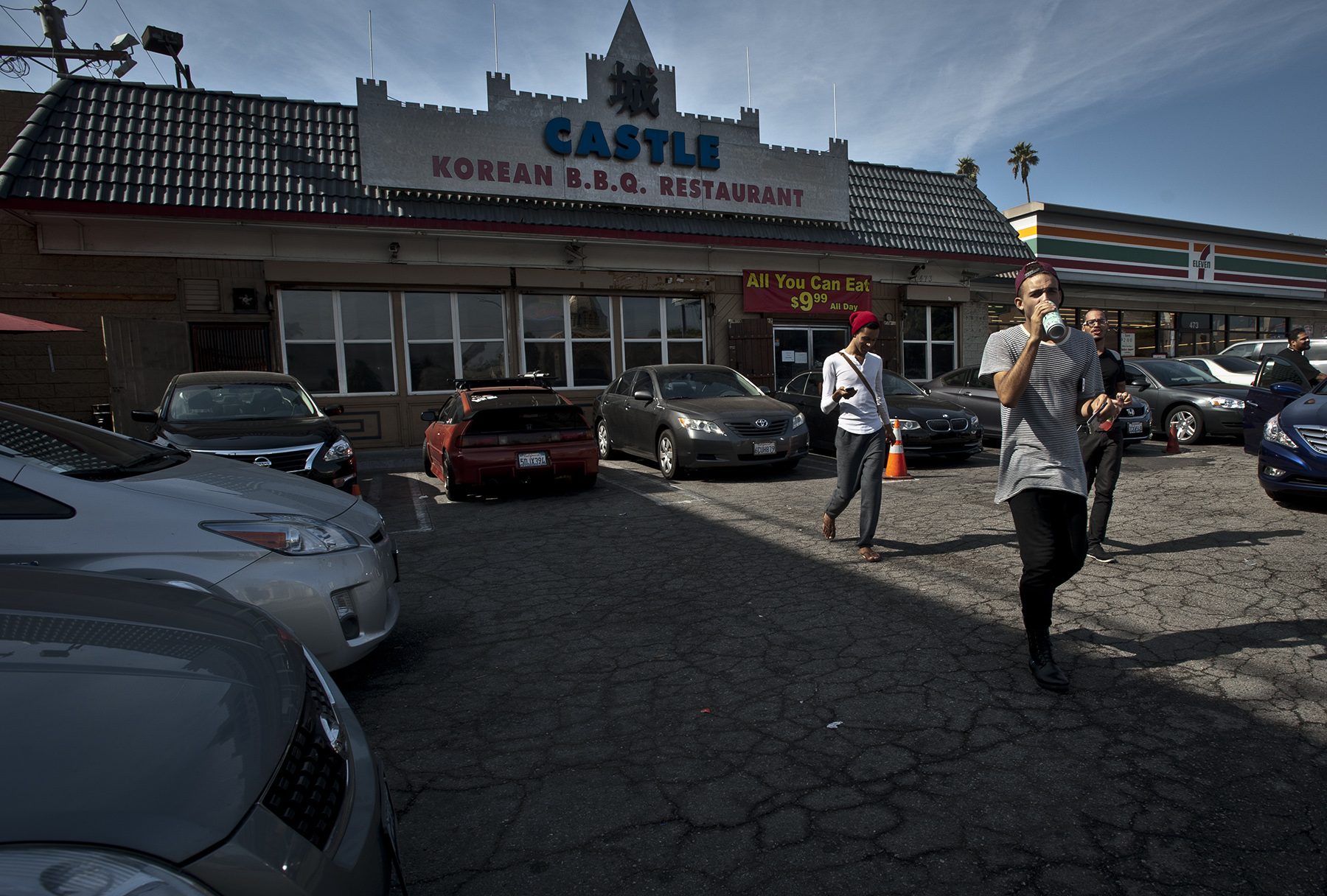
The Castle Korean BBQ restaurant next to the 711 on Western Avenue and Maplewood Avenue


 CONTESTED SPACES